
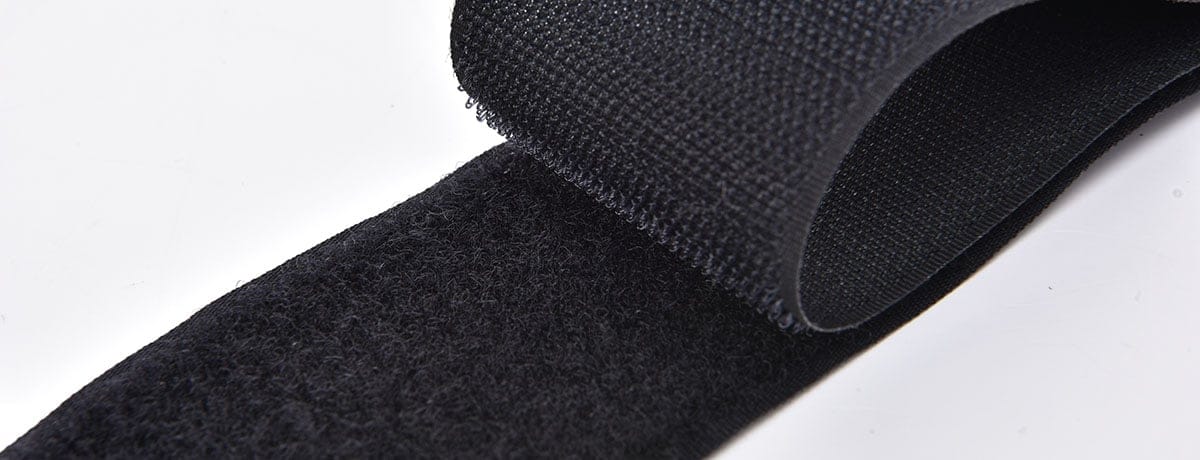
Hook loop Velcro tape, more accurately called hook and loop tape, is a two-part textile fastener: a strip of small stiff hooks that grips a strip of soft loops when pressed together, and releases when peeled apart.
Garment, footwear and home-textile makers, along with medical-product brands, bag makers and trims wholesalers, use it in place of buttons, snaps or zippers wherever a closure needs to be adjustable, fast to open and reusable. This guide explains the main types, nylon and polyester grades, standard widths, common textile uses, how it compares with other closure options, and where MH’s range fits.
Key Takeaways
Hook and loop tape is the generic product; VELCRO® is a brand name for it.
The bond is strongest in shear (sliding) and weakest in peel, which decides where it works on a garment.
Grades run from 100% nylon (Grade A) to 100% polyester (Grade C), with 60/40 and 30/70 blends in between.
Standard widths are 20, 25, 30, 38, 50, 75 and 100 mm; sew-on tape suits fabric, self-adhesive suits hard surfaces.
What Is Hook and Loop Tape?
Hook and loop tape is a pair of narrow woven or knitted tapes. The hook tape carries rows of short, stiff monofilament hooks; the loop tape carries a dense pile of soft multifilament loops. Press them together and hundreds of hooks catch in the loops. Peel them apart and the hooks flex free, ready to close again.
Both halves are textiles, so they're sewn, cut and dyed much like any other narrow fabric. That's why hook and loop sits in the same supply category as webbing and elastic tape rather than with metal hardware. Our hook and loop tape range lists it as "hook and loop closures" or "hook and pile fasteners", the same product under different trade names.
Is Velcro the Same as Hook and Loop Tape?
Not exactly. VELCRO® is a registered trademark of Velcro IP Holdings LLC, the company that first commercialized the fastener. "Hook and loop tape" is the generic name for the product type, made by many manufacturers. The company itself asks the public to say "hook and loop" for the generic product. So "Velcro tape" in a spec sheet usually means hook and loop tape in general, not the branded item.
What Types of Hook and Loop Tape Are There?
There are many hook and loop fastening options on the market, including VELCRO® Brand ranges with over two dozen hook and loop fasteners, but MH's catalog focuses on 11 constructions; the table below covers what each one is and where it's normally used.
Type | How it’s built | Typical uses |
|---|---|---|
Sew-on | Plain woven hook and loop tapes, no backing | Garments, kids' wear, footwear, bags, home textiles |
Self-adhesive | Hook or loop with a pressure-sensitive adhesive back | Smooth indoor surfaces and light-duty mounting projects: displays, panels, packaging, boxes |
Self-adhesive dots | Pre-cut adhesive-backed circles | Signage, small mounts, stationery, light fixtures |
Back-to-back | Hooks and loops on the same side of one tape | Reusable, adjustable wrap straps, cable ties, bundling tapes |
Mushroom hook | Mushroom-shaped hook heads instead of curled hooks | Higher holding force, up to 10 times the tensile strength of traditional hook-and-loop, shoes, heavy straps |
Un-napped loop | Knitted loop with lower, unbrushed pile | Thin, flat closures and laminated parts |
Elastic | Loop surface on an elastic band | Medical braces, sports supports, adjustable bands |
Fire retardant | FR fibers such as aramid | Firefighter and FR workwear, protective gear; can meet aerospace and military safety standards |
Tie tape & cuffs | Pre-made straps with hook and loop ends | Bundling, leg/ankle straps, cable management |
Hair curler pad | Hook surface formed into curler pads | Hair-care products |
Some types change how the tape is attached. Self-adhesive tape isn't meant to be sewn; the adhesive gums the needle. For bonding fabric layers without stitching, garment makers use hot-melt interlining tape, which is a bonding tape, not a fastener.
For wide adjustable supports, MH's 100 mm nylon elastic loop band combines a skin-friendly loop face with an elastic base. For protective clothing, there's an aramid flame-retardant hook and loop tape that sits alongside MH's FR materials.
Nylon vs Polyester: Which Hook and Loop Grade Fits?
Nylon hook and loop tape gives the strongest grip and the longest cycle life; polyester costs less and copes better with moisture and sunlight. Blends sit between the two. MH grades its tape A to C by fiber content:
Grade | Composition | Performance | Where it fits |
|---|---|---|---|
A | 100% nylon | Premium, highest strength | Workwear, footwear, bags, kids' wear, medical supports |
B+ | 60% nylon / 40% polyester | Balanced cost and durability | Mainstream garments and accessories |
B | 30% nylon / 70% polyester | Economical, medium performance | Promotional goods, light-use closures |
C | 100% polyester | Budget option | Packaging, displays, low-cycle uses |
Grade compositions from MH's hook and loop product pages.
What Width of Hook and Loop Tape Do You Need?
Hook and loop tape is sold in standard widths of 20, 25, 30, 38, 50, 75 and 100 mm. Narrow widths suit light closures where the tape should look discreet; wider tapes spread load across more hooks for straps and supports. Outside these metric options, hook and loop tape is also commonly sold from ½” to 6” wide, and rolls can often be cut to the required length.
Width | Typical applications |
|---|---|
20 mm | Cuffs, kids' clothing, small pockets, gloves |
25 mm | General garments, shoe straps, jacket storm flaps |
30 / 38 mm | Bag straps, workwear, outdoor gear, camo military-style kit |
50 mm | Heavy straps, uniforms, medical braces, equipment covers |
75 / 100 mm | Orthopedic belts, wide supports, large covers and panels |
Want a quick rule of thumb? Size the width to the load and the look, then let the grade carry durability. A 20 mm Grade A tape on a child's shoe will outlast a 25 mm Grade C tape, even though it's narrower. Heavy-duty tape is designed for demanding applications with stronger fastening constructions and can hold up to 10 lbs.
Examples from the MH range include a 25 mm sew-on hook and loop tape, a 50 mm 100% nylon hook and loop tape and a 38 mm camouflage-printed nylon tape for tactical and outdoor products.
Where Is Hook and Loop Tape Used in Textiles?
Hook and loop adhesive tape provides reliable fastening for a variety of applications wherever a textile product needs a closure that adjusts, opens quickly or can be fastened with one hand. In garments it replaces buttons and snaps; in home textiles it holds removable covers and panels; in medical and sports goods it makes supports adjustable.
Garments: jacket cuffs and storm flaps, kids' wear, adaptive clothing for people with limited dexterity, workwear pockets.
Footwear: shoe straps for children's, sports and orthopedic shoes.
Bags and outdoor gear: backpack straps, tents, gloves, tactical pouches; self-engaging hook and loop tape is ideal for cable management.
Home textiles and upholstery: removable cushion and seat covers, curtain fixing, mattress covers, plus office organization and classroom activities.
Medical: braces, splints, orthopedic belts and compression wraps, often on elastic loop.
Protective and automotive: FR workwear, headliners, seat covers and door panels.
When the construction and adhesive are chosen correctly, hook and loop tape can secure items in various weather conditions.
Adaptive clothing is a growing use. A strip of hook and loop is far easier to close than a row of buttons for wearers with arthritis or limited hand movement, which is why it's common on adaptive shirts, trousers and shoes. Sew-on tape does not rely on glue, making it more durable for fabrics, and it is extremely durable and washable.
Hook and Loop vs Buttons, Snaps and Zippers
Each closure does a different job. Hook and loop wins on adjustability and ease of use; zippers win on a clean, continuous seal; buttons and snaps win on appearance and a fixed position.
Closure | Adjustable fit | One-hand use | Look | Watch-outs |
|---|---|---|---|---|
Hook and loop | Yes, anywhere along the strip | Easy | Functional, sporty | Hooks catch lint; noisy when opened |
Zipper | No | Moderate | Clean, continuous | Slider can jam or break |
Snap | Fixed positions only | Moderate | Neat, small | Needs punching equipment, fixed spacing |
Button | No | Harder | Classic, decorative | Slow to fasten, buttonholes add steps |
Hook and Loop Tape from MH: Matched to the Garment, Not Just the Spec
MH (Ningbo MH) has supplied garment accessories since 1999, and its hook and loop range is built to be matched: 11 types from sew-on to aramid flame-retardant, four fiber grades from 100% nylon to 100% polyester, widths from 20 to 100 mm, and a card of 210 standard colors with custom shades on request. OEKO-TEX Standard 100 certified tape is available for skin-contact products.
That tape comes from the same group that makes the thread to sew it on, the webbing and elastic it often sits beside, and the zippers and buttons it replaces. MH runs 9 factories covering about 350,000 m², with more than 3,000 employees and 2,000+ partner manufacturers, and ships around 10,000 tailoring materials to customers in over 150 countries under the MH and TWO BIRDS trademarks.
Garment and footwear manufacturers, bag makers, medical-product brands and trims wholesalers can browse the hook and loop range, learn more about MH, or contact MH for a quote by type, grade, width, color and quantity.


Frequently Asked Questions
Is nylon or polyester hook and loop tape better?
Nylon is better for grip and cycle life, so 100% nylon (Grade A) is the usual choice for footwear, workwear and kids' wear. Polyester costs less and handles moisture and UV better, which suits outdoor covers and low-cycle uses. Nylon-polyester blends such as 60/40 balance cost and durability.
What widths does hook and loop tape come in?
Standard widths are 20, 25, 30, 38, 50, 75 and 100 mm. 20-25 mm suits cuffs, kids' clothing and shoe straps; 38-50 mm suits bag straps, uniforms and braces; 75-100 mm suits orthopedic belts and wide supports.
Can hook and loop tape be washed and ironed?
Sew-on hook and loop tape is fully washable; close the hook and loop before washing so the hooks don't collect lint or snag other fabrics. Nylon tape softens around 180°C and melts near 215°C, so iron on a low setting and avoid pressing the hooks directly.
How many times can hook and loop tape be opened and closed?
Quality nylon tape is tested for thousands of cycles. MH's sew-on tape passes a 2,000-cycle peel test while retaining at least 85% of its original tension. Grip drops faster if the hooks fill with lint, so keeping the hook side clean extends its life.