
Elastic Supplier: How to Choose a Reliable Elastic
Choosing the right elastic supplier is one of the most consequential sourcing decisions a garment factory or wholesaler can make. This article gives procurement teams a concrete framework for evaluating elastic and knitted elastic partners at industrial scale, with a focus on MH's positioning as an integrated manufacturer and trader and its broader role as a leading provider of garment accessories and tailoring materials.
Key Takeaways
-
An elastic supplier for B2B buyers must deliver stable make-to-order capacity, consistent quality, and reliable export logistics-not small-lot retail service.
-
MH is a make-to-order elastic supplier with no ready stock, focused on bulk orders for garment factories, wholesalers, and industrial users, including knitted elastics.
-
Buyers should evaluate production capacity, materials specifications, compliance, and long-term partnership terms-not just unit price.
What Is an Elastic Supplier in Modern Apparel and Textile Supply Chains?
An elastic supplier is a B2B manufacturer or trader providing bulk elastic-woven, knitted, braided-to garment factories, medical product makers, home textile brands, and industrial users. The focus is on make-to-order production rather than shelf stock.
Elastic products are used in waistbands, cuffs, lingerie, sportswear, PPE straps, medical braces, and packaging solutions, meaning the supplier's stability directly impacts finished-garment delivery schedules.
Key Types of Elastic Products: Focus on Knitted Elastics
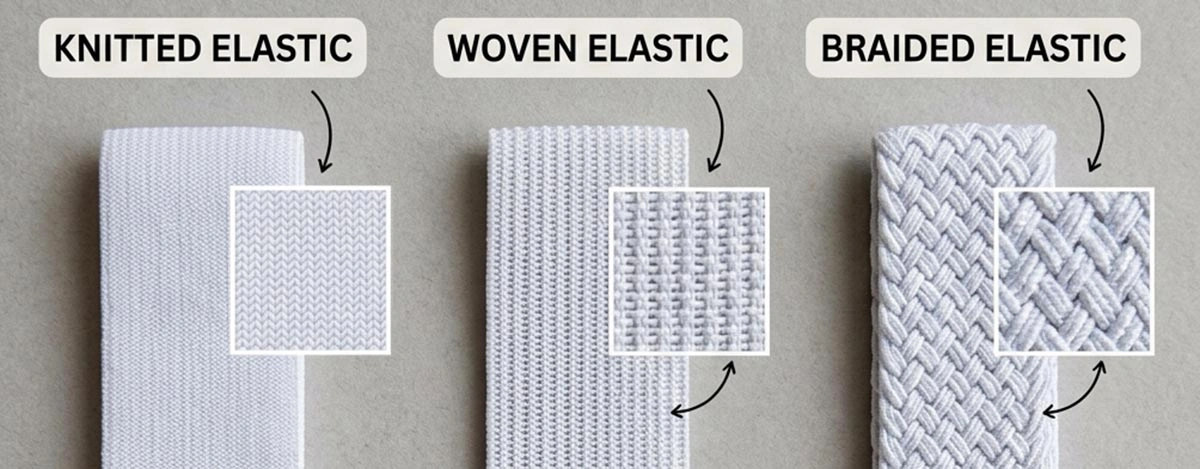
Industrial buyers usually source three core elastic types in bulk. Elastic bands are made from polyester, nylon, or cotton with rubber, and types include woven, knitted, and braided varieties. High-quality elastic uses durable polyester, nylon, or cotton and can be paired with polyester spandex stretch woven fabric for consistent performance over time.
-
Knitted elastics - Constructed on knitting machines with spandex core; soft hand feel, good recovery, does not narrow when stretched. Knitted elastics are ideal for direct sewing into fabric, making them preferred for sportswear waistbands (20–80 mm), lingerie straps, and kidswear alongside trousers waistbands and gripper waist tapes in many garment programs. Customization is essential for unique product branding, and jacquard knitted waistbands with logos or silicone-backed grip elastics exemplify this.
-
Woven elastic - Interlaced warp/weft structure around an elastic core; excellent edge stability, no-roll performance, best for heavy fabric and outerwear, and often used together with durable waterproof Oxford fabric materials in bags and workwear. California Webbing Mills, established in 1950 in Los Angeles, is among the notable webbing and woven elastic producers in the market.
-
Braided elastic - Economical, narrows under stretch, lower durability. Braided elastics are recommended for facemasks, waistbands, and bag and luggage accessories manufacturing where cost matters more than longevity.
The global elastic industry includes specialists across regions: Universal Elastic is the largest manufacturer in Western USA; DG SHANG LIAN was founded in 2001 in Guangdong, China; Brooks Industries has specialized in underwear elastic since 1999. A professional elastic supplier will offer a structured product grid covering flat tapes, jacquard bands, and color-matched elastics for fashion collections, across a variety of sizes and widths, often alongside wholesale chiffon fabric for dresses and linings to support full garment programs.
How to Evaluate an Elastic Supplier for Industrial-Scale Orders
Use this checklist when vetting knitted elastic suppliers:
-
Production capacity: Check suppliers' monthly output for production capacity-ask for tonnage, machine count, and peak-season utilization. Leading elastic suppliers utilize modular production lines to pivot quickly when order profiles shift, and can handle sudden spikes in product demand.
-
Lead times: Expect 20–35 days after color approval for new programs. A capable supplier can rapidly adjust volume or output capacity with minimal lead time, and an elastic supplier dynamically scales resources based on real-time demand fluctuations. The best suppliers provide dynamic capacity that flexes based on live consumption data.
-
Quality management: Request in-house testing data-stretch and recovery cycles, wash performance, color fastness. Obtain technical data sheets for key SKUs with specifications for elongation, shrinkage, and needle damage control, and confirm that compatible wholesale polyester sewing threads are available to match your elastic’s performance.
-
Compliance: Look for manufacturers with OEKO-TEX, ISO, or SGS certifications, especially when sourcing components such as custom OEKO-TEX certified zippers. Chemical safety standards matter for exporting to the EU, US, and Latin American markets. Companies like Elas A/S report 98% on-time delivery and 0.1% claim rates-the kind of performance metrics you should request.
-
Communication: Assess whether the supplier provides a dedicated account manager, order-tracking page, and proactive shipment updates with technical suggestions for optimizing elastic consumption.
-
Cost-performance balance: Focus on total value, not just pricing. Evaluate experience, technologies, and the supplier's ability to meet your requirements over multiple years.
Make-to-Order (MTO) Elastic Supply: Why It Matters More Than Ready Stock
MTO means every batch is produced against a confirmed PO and approved samples-critical for brand consistency and compliance. Elastic suppliers allow businesses to manage operational costs more effectively during market changes by operating without rigid fixed-volume commitments and using flexible inventory strategies, reducing the need for excess stock.
Key advantages of MTO for garment factories:
-
Consistent dye lots aligned with seasonal colors
-
Precise width and elongation tolerances for automated machinery
-
Pricing models tied to actual usage rather than fixed minimum order quantities
-
An elastic supplier helps businesses avoid excess inventory during slow periods, and elastic suppliers charge based on actual usage and provide shared inventory risks
The response to demand changes is faster with elastic suppliers compared to traditional suppliers who rely on static warehousing. MH operates strictly as a make-to-order elastic supplier-customizing knitted elastics for fiber blend, rubber and spandex content, and shrinkage control based on each customer's product requirements. Buyers should integrate MTO lead times into their critical path and forecast elastic needs 2–3 months ahead for stable supply.
Building a Long-Term Partnership with Your Elastic Supplier
Elastic sourcing is a multi-year strategic partnership, with long-term support treated as a service commitment and a guarantee of stable quality, dependable delivery, and follow-through as your business grows. People making sourcing decisions should think beyond the first shipment and evaluate the supplier's readiness to support 3–5 years of business expansion.
-
Lock in core elastic specifications for year-round products (e.g., black and white waistbands for joggers) to reduce re-approval times.
-
Set up annual or semi-annual business reviews covering quality metrics, new product development (softer knitted elastics, recycled yarn options, coordinated embroidery thread product lines), and cost optimization.
-
Share forecasts and style calendars so the supplier can pre-plan raw materials and machine allocation, including supporting items like 150D/2 rayon embroidery thread supply and 40/2 polyester sewing thread programs. Reliable elastic suppliers rely on real-time data sharing to anticipate demand signals and stabilize pricing.
MH strives to be a long-term elastic partner: make-to-order production, stable quality, collaborative development, and committed support for customers' growth. If you have questions about how MH can add value to your sourcing, find us through our website today and return to this page any time for reference.


FAQ
Do elastic suppliers usually keep stock in a small warehouse, or is everything made to order?
Most industrial-focused elastic suppliers, including MH, operate mainly as make-to-order producers with manufacturing scheduled against demand rather than pulled from stock. Each batch is planned against a confirmed order and approved sample to ensure consistent width, stretch, and shade.
How far in advance should I place orders for make-to-order elastic?
Plan 2–3 months ahead of your sewing start date, allowing time for sample approval, production, and ocean shipping. Repeat orders of existing approved specs can sometimes run on shorter lead times and may also be released by spool for standard bulk programs where approved specs are already in place. Large garment factories should share quarterly forecasts so the supplier can reserve capacity and raw materials in advance.
Can one elastic supplier handle both fashion items and technical applications like medical braces?
Many elastic suppliers produce a broad range-fashion waistbands, lingerie elastics, and functional elastics-but technical applications like medical braces may require specific testing and certifications. Share end-use requirements and regulatory standards at the RFQ stage. MH focuses on industrial-grade bulk elastics for apparel and related sectors and can discuss specialized applications case by case.
How can I check whether an elastic supplier is reliable without visiting the factory?
Request detailed company profiles, confirm where the supplier is located, and check whether the factory is in the heart of a key textile or export region, along with production photos, testing reports, and references from B2B customers in similar markets. Start with a trial order for a limited number of knitted elastic SKUs, monitoring quality, communication speed, and on-time delivery performance before scaling up. Third-party inspection agencies can also conduct factory audits and pre-shipment checks when on-site visits are not feasible.
