
Fabric Camouflage: Technical Guide for Bulk Buyers and Manufacturers
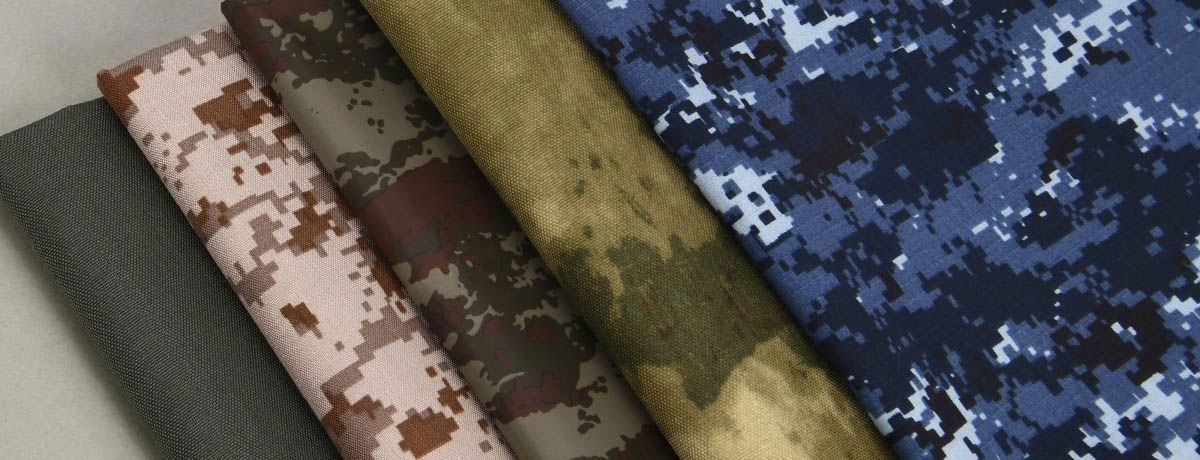
When sourcing textiles for uniforms, tactical gear, or outdoor apparel, understanding the technical aspects of fabric camouflage can make the difference between a successful production run and costly quality issues. This guide breaks down everything B2B buyers need to know—from base fabric selection to printing methods and performance specifications.
Whether you’re a garment manufacturer evaluating new suppliers or a purchasing manager preparing tender specifications, this article provides the practical knowledge required for informed sourcing decisions.
What Is Camouflage Fabric?
Camouflage fabric refers to textile substrates—both woven and knitted—that carry printed or dyed disruptive patterns designed to reduce visual detection in specific environments. The pattern disrupts outlines and blends with natural or artificial surroundings, making it functional for concealment rather than purely decorative.
In a B2B context, camo fabric mainly refers to bulk-printed materials for uniforms, workwear, hunting apparel, and tactical gear rather than retail yardage sold by the yard for quilting or home projects like curtains.
-
Pattern vs. base distinction: The camouflage pattern (woodland, digital, desert, Multicam-type, urban, snow) is separate from the fabric base (cotton, polyester, nylon, blends). Buyers specify both independently.
-
Typical GSM ranges: Apparel-grade fabrics generally run 160–280 gsm, outerwear and jackets 210–320 gsm, and technical equipment fabrics range from 70D to 1000D depending on application.
-
Primary use cases: Military-inspired uniforms, security workwear, hunting gear, tactical equipment, bags, covers, and outdoor shelters.
-
Not fashion-driven: Unlike retail camo used in fashion collections featuring bold colors like pink or purple, B2B camouflage fabric prioritizes functional concealment and durability over trend cycles.
Common Fabric Bases Used for Camouflage (Woven & Knitted)
Fabric base selection depends entirely on end-use requirements. Uniforms, hunting apparel, workwear, tactical gear, bags, and outdoor equipment each demand different performance characteristics from their base textiles.
Woven Cotton Poplin and Twill
-
Composition: 100 cotton construction in poplin or twill weaves
-
Weight ranges: 130–220 gsm for poplin (shirts, lightweight jackets) and 200–280 gsm for twill (trousers, field jackets)
-
Advantages: Excellent breathability, natural comfort, good printability with reactive or pigment dye systems
-
Applications: Standard work uniforms, low-to-medium intensity field use, base layers where comfort is prioritized over technical performance
Polyester/Cotton (T/C and CVC) Blends
-
Common ratios: 65/35 T/C, 60/40 T/C, 55/45 CVC, 80/20 CVC
-
Weight ranges: 180–260 gsm for most uniform applications
-
Advantages: Balanced strength, improved dimensional stability over pure cotton, cost-effective for large orders
-
Applications: Police uniforms, security workwear, logistics teams, industrial settings where durability and easy-care properties matter
Nylon and Nylon Blends (NyCo)
-
Construction types: 160–220 gsm twills and 200–260 gsm ripstop variants
-
Advantages: Superior abrasion resistance, high tear strength, quick-dry performance
-
Applications: Tactical uniforms, load-bearing equipment, outdoor gear where mechanical durability and moisture management are critical
Polyester Woven Technical Fabrics
-
Light technical: 70D–300D plain or ripstop for rainwear, ponchos, tents, shelters
-
Heavy technical: 300D–600D Oxford for bags, soft equipment, covers
-
Coating options: PU or PVC coating, laminated membranes for waterproof or windproof products
-
Applications: Equipment covers, tactical bags, outdoor shelters requiring weather protection
Knitted Bases (Jersey, Interlock, Pique, Mesh)
-
Cotton and cotton/spandex jersey: 160–220 gsm for t shirts and base layers
-
Polyester/spandex performance knits**: 180–260 gsm for athletic and tactical base layers
-
Mesh constructions: 100% polyester mesh (typically 60” wide) for sportswear linings, breathable hunting garments, and ventilation panels
-
Applications: Base layers, performance apparel, lightweight activewear where stretch and moisture-wicking are priorities
Camouflage Pattern Design and Specification
For bulk production, patterns are handled as technical files with precise repeats and color standards—not simply as visual artwork to be interpreted by printers. Getting specifications right at this stage prevents costly corrections during production.
Pattern Categories
-
Main types: Woodland, desert, digital/pixelated, urban grey-scale, snow white/grey, and multi-environment patterns
-
Selection criteria: Pattern choice is driven by buyer’s operational environment or brand requirements, not fashion trends
-
Custom patterns: Many institutional buyers require proprietary designs that must be managed as controlled assets
Pattern Repeat and Scale
-
Typical repeat sizes: 45–64 cm for apparel applications; larger repeats for shelters, covers, and equipment
-
Production impact: Repeat size and motif scale affect fabric yield, cutting marker efficiency, and visual effect on finished garments
-
Scale considerations: Smaller motifs work better on fitted items like t shirts; larger patterns suit outerwear and bags
Color Standards and Tolerances
-
Reference systems: Pantone TPX references, lab dip approvals, or client-specific color standards
-
Tolerance requirements: ΔE ≤ 1.0–1.5 for critical contracts; standard commercial tolerances may allow ΔE ≤ 2.0
-
Lot consistency: Tight color control ensures pattern integrity across multiple production batches—essential for uniforms and multi-year contracts
File Formats and Pre-Production
-
Standard formats: High-resolution vector (AI) or raster files (PSD, TIFF) compatible with rotary or digital printing systems
-
Screen preparation: Rotary printing requires engraving separation files with clear color channels
-
Approval workflow: Colorway confirmation via strike-offs before bulk production protects both buyer and supplier
Printing and Dyeing Methods for Camouflage Fabrics
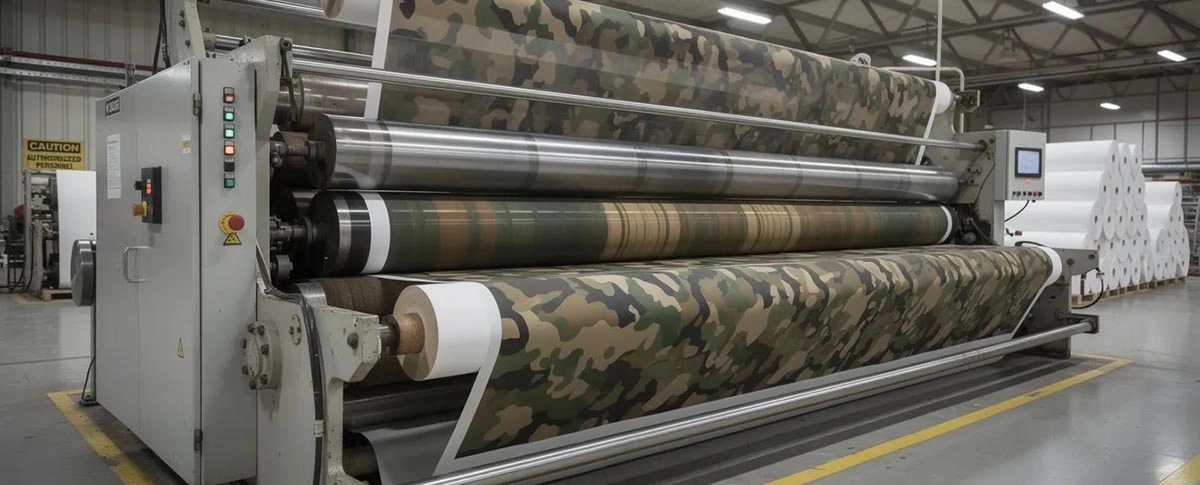
The primary bulk production methods for camouflage fabric include piece dyeing as base preparation, screen printing (rotary and flat), and digital printing. Each method offers different cost structures, volume thresholds, and quality characteristics.
Piece Dyeing as Base Preparation
-
Many camo fabrics start from piece-dyed base shades (solid khaki, olive, tan) to improve print coverage and back-side appearance
-
Continuous dye ranges handle cotton and blends; jet dyeing suits synthetics
-
Pre-dyed bases reduce the amount of ink required for full pattern coverage
Rotary Screen Printing
-
Volume sweet spot: Mainstream method for large-volume production—thousands to tens of thousands of meters per pattern
-
Technical requirements: One screen per color; camouflage patterns typically require 4–8 screens
-
Advantages: Stable color registration, high productivity (up to 50+ meters per minute), excellent reproducibility
-
Best for: Stock programs, long-term contracts, patterns with consistent demand
Flat Screen Printing and Transfer Printing
-
Suitable for smaller or specialized runs where rotary screen investment is not justified
-
Works well with heavier bases and coated or laminated fabrics
-
Transfer printing options available for polyester bases requiring detailed pattern reproduction
Digital Printing
-
Growing adoption: Ideal for shorter runs, frequent pattern updates, or complex multi-color designs
-
Cost structure: Higher per-meter cost than rotary but eliminates screen engraving expenses
-
Lead time advantage: Speeds sampling, pattern validation, and quick-turn orders
-
MOQ flexibility: Lower minimums make it great for development and small batch production
Yarn-Dyed and Woven-In Camo Structures
-
Some technical camouflage effects achieved via yarn-dyed weaves or jacquard constructions
-
More common in equipment textiles than apparel due to design limitations
-
Offers unique texture and depth not achievable through surface printing
Color Fixation and Washing
-
Fixation method (steam, heat, chemical) depends on dye class: reactive for cotton, disperse for polyester, acid for nylon, pigment for blends
-
Controlled washing and soaping processes are required to meet color fastness standards for export markets
-
Improper fixation leads to pattern fading, color migration, and failed compliance testing
Key Performance Characteristics for B2B Camouflage Fabric Sourcing
Buyers should define performance requirements in terms of recognized standards (ISO, AATCC, EN) to ensure fabric matches application needs and contract specifications. Vague requirements lead to disputes; measurable specifications create accountability.
Durability and Mechanical Strength
-
Tensile strength: Requirements vary by application—workwear typically >400N, tactical gear often >500N
-
Tear strength: Ripstop constructions target >20N minimum; heavy-duty applications may require >40N
-
Abrasion resistance: Martindale or Wyzenbeek cycle requirements depend on wear intensity (5,000–50,000+ cycles)
Color Fastness
-
Washing fastness: ISO 105-C06 testing; minimum grade 4 for commercial applications, grade 4-5 for demanding contracts
-
Rubbing/crocking: Dry and wet crocking tests (AATCC 8); poor results indicate inadequate dye fixation
-
Perspiration and light fastness: Critical for outdoor and workwear applications with prolonged sun exposure
-
Impact of failure: Poor fastness causes pattern fading and color shift, affecting both function and compliance
Dimensional Stability and Skew
-
Shrinkage targets: Within ±3% in warp and weft after washing for apparel-grade fabrics
-
Spirality control: Essential for printed knit fabrics like t shirts and base layers where twist distorts pattern alignment
-
Testing protocols: ISO 6330 or equivalent wash procedures for dimensional change assessment
Comfort and Handle
-
Air permeability: Quantified in cm³/cm²/s; higher values for hot-climate uniforms
-
Moisture management: Wicking finishes move perspiration away from skin; important for base layers and hunting apparel
-
Thermal comfort: Relevant for both hot and cold climate applications
-
Surface treatments: Peaching, brushing, or mechanical softening for improved skin contact
Functional Finishes
-
Water-repellent (DWR): Fluorocarbon-free options increasingly specified for environmental compliance
-
Waterproof/breathable: Coatings or laminations for outerwear and rain gear
-
Flame-retardant (FR): Required for certain industrial and protective workwear sectors
-
Additional options: Anti-static, oil/soil release, antimicrobial treatments
-
Interaction note: Each finish can affect print appearance and hand-feel—testing with the chosen camo pattern is essential
Regulatory and Safety Compliance
-
OEKO-TEX STANDARD 100: Commonly requested for apparel touching skin
-
REACH compliance: Required for EU market access
-
FR certification: Specific norms apply to protective workwear (EN ISO 11612, NFPA 2112)
-
Documentation: Repeatable test reports and certificates are important for tenders and institutional contracts
Industrial and Commercial Applications of Camouflage Fabrics
Camouflage fabrics serve both functional concealment and corporate/brand identity roles across multiple sectors. The ideal fabric choice depends on balancing performance requirements with cost and production constraints.
Uniforms and Workwear
-
Applications: Military-inspired field uniforms, security personnel, forestry workers, wildlife management, logistics teams
-
Typical fabrics: Cotton/polyester twills and ripstops, 190–260 gsm
-
Key requirements: Good color fastness, durability, dimensional stability through repeated industrial laundering
-
View from production: These applications often involve long-term contracts requiring consistent stock availability
Hunting and Outdoor Apparel
-
Applications: Jackets, pants, vests, base layers, and accessories for hunters and outdoor enthusiasts
-
Fabric requirements: Quiet-hand fabrics that don’t rustle, breathability, weather resistance
-
Common bases: Brushed polyester, microfleece, softshell, lightweight ripstop with camo prints
-
Performance focus: Hunters prioritize concealment effectiveness alongside comfort for long periods in the field
Tactical and Protective Gear
-
Applications: Plate carrier covers, pouches, backpacks, holsters, belts, ballistic vest covers
-
Fabric specifications: Heavy nylon and polyester, 500D–1000D constructions, laser-cuttable composites
-
Key properties: High abrasion resistance, tear strength, compatibility with MOLLE/PALS attachment systems
-
Advanced options: IR-suppressing treatments for reduced thermal signature in specialized applications
Bags, Covers, and Equipment
-
Applications: Duffle bags, rifle cases, tent flies, tarps, equipment covers
-
Fabric preferences: Coated polyester or nylon with printed camo
-
Performance requirements: Water repellency, UV stability, mildew resistance
-
Treatment options: FR treatments for certain storage or transport applications
Institutional and Commercial Projects
-
Applications: Training facilities, theme parks, exhibition stands, brand promotions, acrylic signage
-
Key consideration: Consistent pattern reproduction across multiple product categories
-
Scale requirements: Large-format prints for environmental applications may require specialized equipment
-
Color matching: Strict adherence to brand standards across different fabric bases
Bulk Sourcing Considerations for Camouflage Fabrics
B2B buyers should evaluate suppliers not only on unit price but also on production continuity, technical capability, and pattern management systems. The perfect price means nothing if quality varies between lots or delivery schedules slip.
Minimum Order Quantities (MOQs) and Lead Times
-
Rotary-printed camo: Typical MOQs range from 2,000–5,000 meters per colorway
-
Digital printing: Lower MOQs available—often 300–1,000 meters—making it ideal for sampling or limited runs
-
Standard lead times: 4–8 weeks from lab dip/strike-off approval to bulk shipment, depending on complexity
-
Planning importance: Factor in repeat order lead times for ongoing programs; rushing orders increases error risk
Batch Consistency and Lot Control
-
Consistent shade, weight, and hand-feel across production lots is essential for uniforms and multi-year contracts
-
Suppliers should maintain reproducible dye and print recipes with documented batch numbers
-
Traceability systems allow investigation of quality issues and prevent recurrence
-
Request shade bands and weight tolerances as part of order specifications
Testing, Certification, and Documentation
-
Request test reports for color fastness, physical properties, and any FR or functional claims
-
Prefer reports from recognized laboratories (SGS, Intertek, Bureau Veritas)
-
Technical data sheets (TDS) provide a basis for internal evaluation and customer communication
-
Maintain a library of approved samples for comparison with incoming shipments
Customization and Pattern Management
-
Many buyers require custom colorways or proprietary camouflage designs
-
Artwork handling should include clear agreements on file security, NDAs, and controlled pattern usage
-
Discuss exclusivity terms where patterns represent competitive advantage
-
Ensure suppliers have secure pattern storage and version control systems
Logistics and Packaging
-
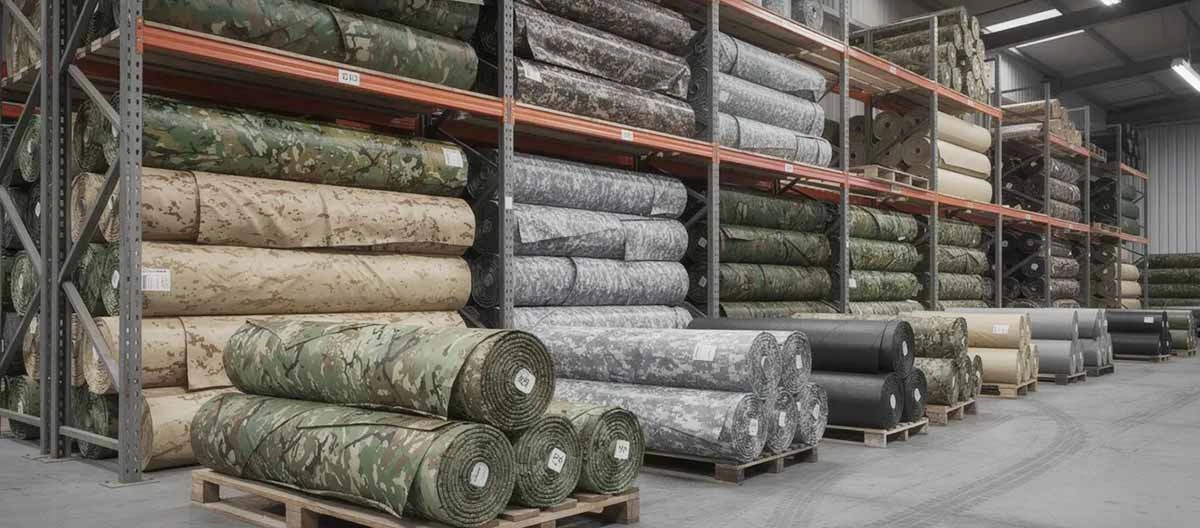
Standard roll lengths, roll packing specifications, and bale weight limits should be confirmed before order
-
Proper labeling (lot numbers, color codes, meter counts) supports warehouse management and conversion planning
-
Discuss packaging options that prevent damage during shipping and storage
-
For ongoing programs, establish consistent packing standards to streamline receiving processes
Key Takeaways
Sourcing camouflage fabric for bulk production requires attention to multiple technical factors beyond pattern design. Base fabric selection, printing method, performance specifications, and supplier capability all influence the success of your production program.
Here’s what matters most:
-
Match fabric base to application: Cotton for comfort, blends for durability, synthetics for technical performance
-
Specify standards, not descriptions: Use measurable requirements (AATCC, ISO, EN) rather than subjective terms
-
Evaluate printing methods by volume: Rotary for high-volume consistency, digital for flexibility and lower MOQs
-
Prioritize lot consistency: Shade variation between batches creates problems in uniform production
-
Document everything: Test reports, technical data sheets, and approved samples protect both parties
Whether you’re adding camo options to your collection or fulfilling a large institutional order, the right supplier partnership makes all the difference. Request samples, review test documentation, and confirm production capability before committing to bulk orders.
For manufacturers and wholesalers building reliable supply chains, understanding these technical fundamentals helps you make sourcing decisions that support quality, consistency, and long-term business relationships.