
Hook Eye Closure: Industrial-Grade Solutions for Garment Manufacturers
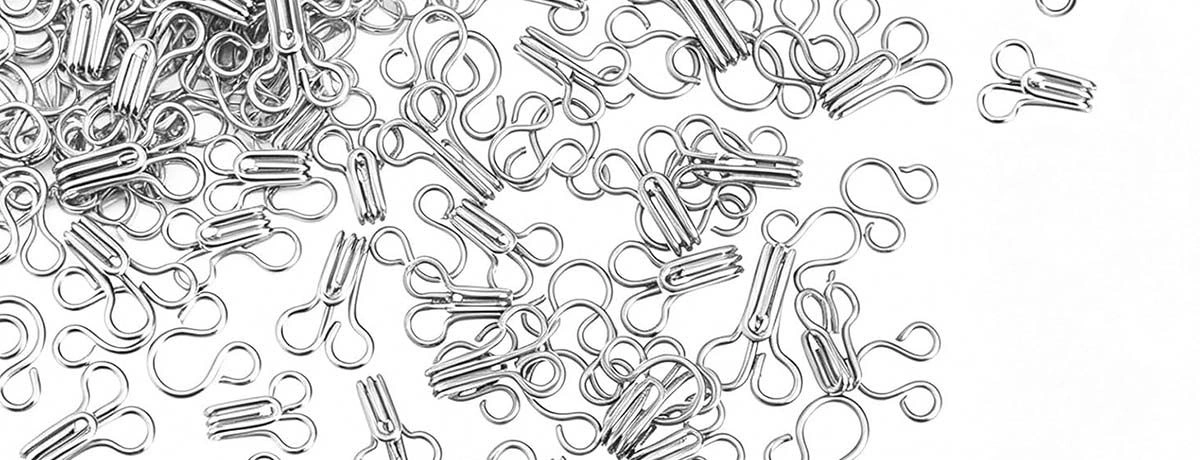
Choosing the right hook and eye closure for mass production is not a retail decision-it is a supply chain decision.
Key Takeaways
-
Hook and eye closures are critical for secure, discreet garment fastening across dresses, lingerie, uniforms, and outerwear, and this guide focuses exclusively on B2B sourcing, specifications, and quality control.
-
MH supplies hook and eye closure solutions on a Make-to-Order (MTO) basis only, with no ready stock, optimized for bulk orders and continuous production runs.
-
MH maintains a stable supply chain with large-scale capacity and long-term export experience serving garment factories in Latin America and other global markets.
-
The guide explains how to choose the right closure type, size, finish, and packaging for each garment category at industrial scale.
Overview of Hook and Eye Closure for Industrial Garments
A hook and eye closure comprises two components: the hook (a curved metal wire or stamped piece) and the eye (a loop or bar into which the hook latches). Unlike zippers, snaps, or buttons, hook and eye closures have no moving parts that can jam or break. They lie flat against the fabric, making them nearly visible only under close inspection, and they provide discreet fastenings without visible bulk. They are lightweight and inexpensive to manufacture at scale, and they integrate easily with standard polyester sewing threads used in mass production.
The eye closure is the receiving component that partners with the hook. Both parts must be specified correctly in bulk orders-mismatch in dimensions or interlocking fit leads to alignment failure on production lines. Hook and eye closures are useful for securing zippers at the top and can be used in a variety of garment closures including necklines and waistbands.
This article is written for professional buyers, sourcing managers, and garment factory owners-not home sewers. MH operates as an integrated textile manufacturer and trader supplying MTO hook and eye closure solutions, integrated with broader trim programs for international brands.
Types of Hook and Eye Closures Used in Mass Production
This section classifies hook and eye closures by construction and application relevant to factory procurement.
-
Single-pair sets: Classic closures for dresses, blouses, trousers, and suiting waistbands. Made from wire-formed or stamped metal (steel, brass, stainless steel). In standard attachment, operators sew the hook 1/8 inch from the garment edge, use 16–18 inches of thread, and secure the hook with 2–3 stitches around its body. Blanket stitches are used around the loops of the hook. Operators then attach the eye after sewing the hook into place and stitch around the eye's loops 2–3 times for stability.
-
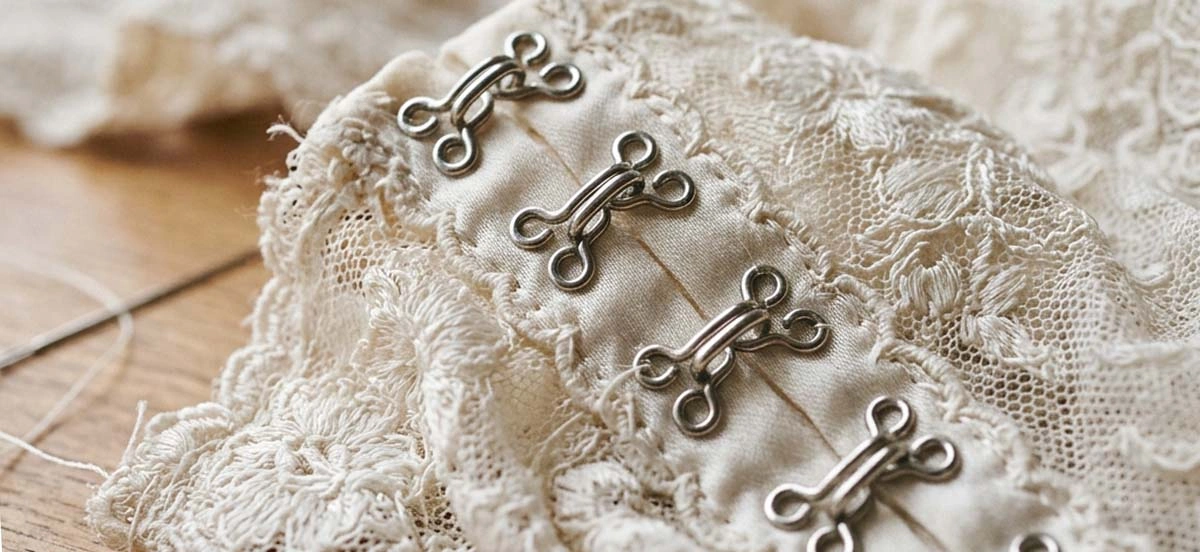
Multi-row hook and eye tape: Used extensively in undergarments like brassieres and corsets, shapewear, and lingerie. Configurations such as 2×3, 3×3, and 4×3 are standard. Multiple rows of hooks and eyes offer adjustable sizing solutions and typically secure the ends of nylon or metal zippers. MH's 4×4 5/8-inch stainless steel bra closure is a representative example of this category.
-
Heavy-duty closures: Designed for heavier fabrics, outerwear, uniforms, protective clothing, and technical products like bags and luggage that use coordinated bag and luggage accessories such as zippers and hardware. Heavy-duty hook and eye fasteners are designed for tough fabrics with thicker wire gauge and reinforced attachment points.
-
Invisible closures: Invisible hook and eye fasteners provide discreet closures for eveningwear, bridal, and tailored garments where the closure must not be visible on the outside shell. Straight bar eyes are typically selected for overlapping constructions.
-
Decorative closures: Decorative hook and eye fasteners enhance garment aesthetics with plated finishes (antique brass, gunmetal, bronze), ornamental shapes, or custom logo stamping for fashion-forward collections, and can be coordinated with other visible hardware such as decorative curtain grommets and eyelet rings in home-textile programs.
-
Pre-attached on tapes: Available on woven or knitted tapes for faster machine attachment, reducing manual handling and increasing throughput on production lines. Easy to integrate with semi-automatic sewing equipment.
Material, Size, and Finish Specifications for Eye Closures
Exact specification of materials, dimensions, and finishes is critical for consistent performance across thousands of garments per style. Even minor deviations cause line stoppages and rework, just as incorrect ticket counts or tensile strength in 40/2 polyester sewing thread for garment assembly can disrupt sewing efficiency.
Hook and eye fasteners come in various sizes. Common sizing runs from #0 (~9 mm, ideal for delicate necklines) through #4 (~25 mm, for waistbands and outerwear). For tapes, width (e.g., 5/8 inch) and row/column count define the closure's density. Metal, plastic, and nylon options are available for hook and eye fasteners, though metal remains the standard for industrial garment production.
Surface finishes include nickel, nickel-free silver, black oxide, antique brass, and lacquered color options. Color coordination matters: tape bases must match garment fabric in white, black, nude, or custom-dyed tones, confirmed through lab-dip approval before bulk production.
Application Scenarios: Matching Hook and Eye Closures to Garment Categories
Correct hook and eye closure selection depends on garment category, target market, and expected wear conditions. Here is how to find the perfect fastener for each project:
-
Womenswear dresses and blouses: Small, discreet eye closures (#0–#2) at necklines and back zippers. Finishes must close with zipper color. The closure must look invisible against fine woven and knit fabrics, especially when paired with chiffon fabric for dresses and blouses.
-
Lingerie and underwear: Multi-row hook and eye tapes with soft backings against the body. Must endure frequent wash cycles and maintain fit across the garment's lifespan. This is where adjustable sizing is most appreciated by end consumers.
-
Uniforms and corporate wear: Robust clasps with consistent sizing across multi-year supply contracts. Lot-to-lot consistency in dimensions is essential for standardized sewing line set-ups.
-
Heavy outerwear and workwear: Heavy-duty hook and eye closures that can withstand repeated stress, weight, and environmental exposure, working together with structured waistband gripper tape and waistband lining to maintain garment shape and fit. Stainless steel or thick plated steel is the reliable choice for these applications.
-
Bridal, eveningwear, and costumes: Invisible or decorative hook and eye closures that add aesthetic value while supporting fit-critical functions. Custom plating and precise color matching are standard requirements.
Partnership Advantages with MH for Long-Term Eye Closure Supply
Working with an integrated MTO supplier like MH eliminates the complexity of managing multiple small vendors for hook and eye closures.
-
Consolidated trim sourcing: Combining hook and eye closures with labels, tapes, elastics, and related textile accessories from MH simplifies vendor management and reduces administrative overhead.
-
Volume stability: MH supports large global brands and regional labels with stable capacity across multiple seasons, reducing the risk of stock-outs and last-minute sourcing scrambles. MH does not keep stock-every order is manufactured to your specifications.
-
Technical collaboration: MH aligns eye closure specifications with brand technical packs and participates in early development meetings, so design teams can read requirements and plan accordingly.
-
After-sales support: Troubleshooting attachment issues on the production line, recommending suitable hook and eye closures for new fabrications, and assisting with testing protocols are all part of the partnership.
Professional buyers are encouraged to share their forecasted needs and technical requirements so MH can propose a tailored, Make-to-Order hook and eye closure program that helps streamline production and protect brand quality.


FAQ: Hook and Eye Closures for Professional Buyers
What information do you need to quote a Make-to-Order hook and eye closure program?
-
Provide closure type (single pair, tape, heavy-duty, decorative), size, material preference, finish or color, and any brand compliance standards.
-
Include annual or seasonal volume forecasts, country of destination, and target delivery windows so MH can plan material sourcing and production capacity.
-
Sharing tech packs, reference samples, or photos of existing eye closures speeds up accurate costing and development.
Can MH match existing hook and eye closures already approved by our brand?
-
MH can reverse-engineer eye closures from physical samples, matching size, shape, plating, and tape color within agreed tolerance.
-
Lab dips and pre-production samples are supplied for approval before bulk production, ensuring alignment with brand standards.
-
Any changes needed for compliance or durability are discussed with the buyer before final confirmation.
How do you control quality and consistency across large production runs?
-
MH conducts in-line and final inspections including dimensional checks, plating thickness verification, and random functional tests for hook and eye closure strength.
-
Batch traceability and retention of reference samples for each production lot support future investigations and repeat orders.
-
Buyer-specific testing protocols (e.g., additional corrosion or wash tests) can be integrated into MH's QC process.
Do you support compliance with nickel-free and other restricted substance requirements?
-
MH supplies nickel-free eye closures and meets major retailer and international standards for harmful substances.
-
Third-party test reports or internal lab reports are provided as part of the documentation set for bulk shipments.
-
Buyers should share the latest versions of their compliance manuals to ensure full alignment.
