
What Is 100% Polyester Mini Matt Fabric and Why Is It Popular for B2B Buyers?
Key Takeaways
-
100% polyester mini matt is the institutional uniform standard for wrinkle resistance, easy care, and consistent large-order quality.
-
MH supplies OEKO-TEX® certified mini matt from China with MOQ 5,000 m/color and full custom color matching.
-
Mini matt outperforms gabardine on maintenance cost; outperforms twill on professional appearance.
What Is 100% Polyester Mini Matt Fabric?
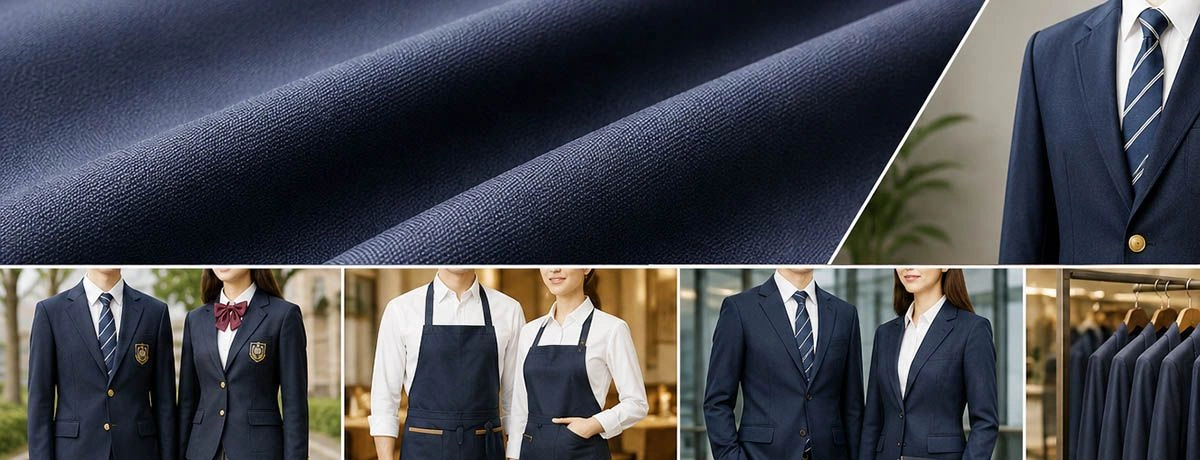
100% polyester mini matt is a plain 1/1 woven polyester fabric with a fine, uniform grid surface and a matte finish, typically ranging from 160gsm to 300gsm. Its tight, balanced weave keeps it lightweight with decent airflow and comfort while still maintaining a structured presentation, making it the institutional uniform standard for buyers who need consistent appearance and low maintenance across thousands of garments.
The “mini matt” name refers to the fabric’s fine-grid plain weave — a miniature version of the matt weave family. Every warp yarn interlaces with every weft yarn at regular intervals, creating a surface that’s dimensionally stable, smooth, and resistant to yarn movement. That stability is exactly what gives mini matt its wrinkle-resistance: the interlacing is too tight for the yarns to shift out of place.
Core specifications at a glance:
-
Weave structure: Plain 1/1 — balanced warp and weft interlacing
-
Fibre content: 100% polyester filament (150D and 300D are the most common yarn counts for uniforms)
-
Weight range: 160gsm (lightweight, summer uniforms) through 200gsm (year-round) to 280–300gsm (heavyweight workwear and blazers)
-
Surface: Matte, fine grid, smooth — professional appearance, with dyed and printed colors available for buyers who want to create custom garment programs
-
Key distinction: Mini matt is a woven fabric, not a knit or brushed textile. Buyers sometimes confuse it with microfibre — they’re structurally different products.
Mini matt for workwear applications uses a 100% polyester plain 1/1 weave at 160gsm, producing a fabric with wrinkle resistance, wear resistance, and fade resistance that makes it suitable for long-term institutional uniform use. The balanced weave structure is the key differentiator from other mini matt fabric variations for uniforms and workwear and twill-based alternatives.
Applications: Where Is Mini Matt Used?
Mini matt's three core B2B markets are school uniforms, corporate workwear, and professional apparel — three sectors where the fabric's low-maintenance profile, consistent appearance, and bulk-order availability directly address procurement requirements.
School Uniforms
This is mini matt's highest-volume application. Navy, grey, black, and burgundy in 160–200gsm are the standard specification for trouser, skirt, blazer, and waistcoat fabrication. The fabric handles the physical demands of a school day — it doesn't tear at seams during sports, doesn't pill at the elbows after one term, and doesn't fade to a different shade after the summer holidays.
For multi-year uniform supply contracts, color consistency across re-orders is equally critical. A school specifying "navy blue" in year one needs the same navy blue in year three. Polyester mini matt's dye stability makes that achievable in a way cotton cannot reliably deliver.
Recommended weight: 160–200gsm for year-round school uniform use in temperate climates. 120–150gsm variants suit tropical or year-round warm climates.
Corporate Workwear
Hotels, airlines, retail chains, healthcare facilities, and food service operators source mini matt for front-of-house staff uniforms and hospitality aprons. The 200gsm mid-weight handles everyday front-of-house demands; 280–300gsm suits kitchen and hospitality environments where the garment takes more physical punishment. It also holds up to daily staining and repeated heavy laundering in uniform and workwear programs, while four-way polyester spandex stretch woven fabrics for suits and trousers can be specified for roles needing greater freedom of movement.
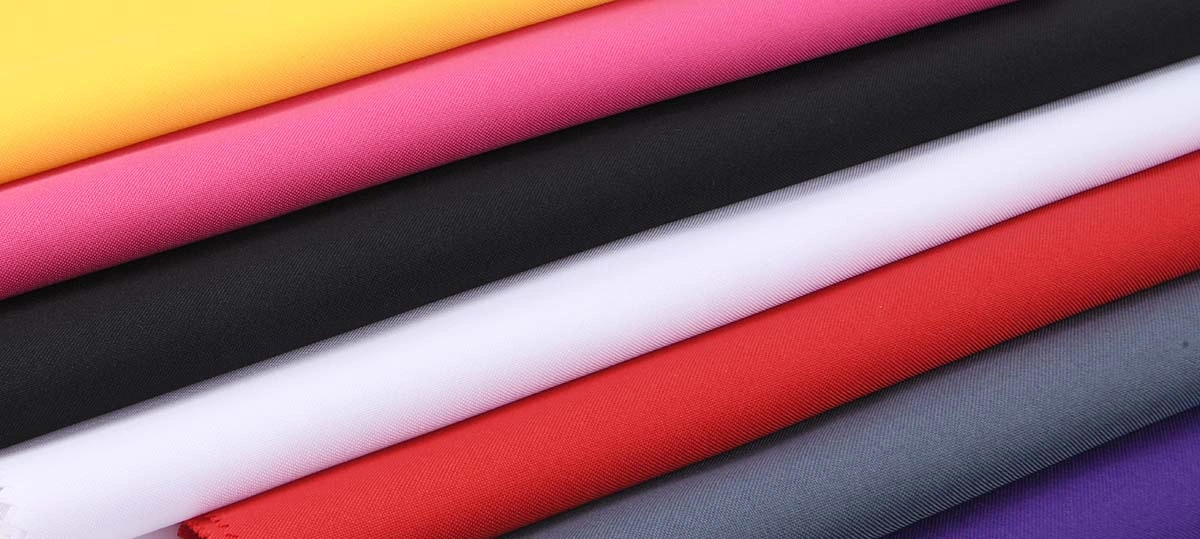
Brand colour matching is central to this application. A hotel chain with 40 properties across three countries needs every uniform garment to carry the identical Pantone shade. Mini matt’s dyeing flexibility — it works with standard disperse dye systems and Pantone-matching processes — makes that consistency achievable at scale.
Professional and Career Apparel
Lighter 160gsm mini matt drapes cleanly for tailored trousers, skirts, and blazers in business and professional services environments. The matte surface reads as appropriately formal without the sheen of satin-finish fabrics. Beyond garments, some buyers also use it to create unique decorative products such as cushion covers, low-maintenance curtains, and affordable upholstery, often pairing mini matt with wholesale chiffon fabric for dresses, scarves, and linings in coordinated programs. Growing demand comes from corporate Asia-Pacific markets — Japan, South Korea, Singapore — where formal dress codes remain standard, and from uniform refreshes in the European financial and legal sectors.
Mini matt fabric’s three primary B2B markets — school uniforms, corporate workwear, and professional apparel — collectively represent a combined addressable market exceeding USD 50 billion in 2026, with polyester-based materials holding a 44.1% share of the school uniform segment alone. For outdoor or bag applications associated with these programs, buyers often complement garments with durable waterproof Oxford fabrics for accessories like backpacks and protective covers.

B2B Buyer Benefits: What Procurement Managers Actually Care About
For B2B procurement managers, mini matt’s value goes beyond fabric properties. The commercial case rests on four advantages: predictable quality at volume, total cost of ownership, compliance certifiability, and order flexibility, including sourcing by the meter or in rolls of about 50 meters depending on supplier terms.
|
Buyer Benefit |
What It Means in Practice |
|---|---|
|
Consistent quality at MOQ 5,000m+ |
Same hand-feel, colour, weight across every roll in an order |
|
Low total cost of ownership |
~30% fewer replacement cycles vs cotton — lower 5-year program spend |
|
OEKO-TEX® certified |
Meets school and institutional procurement compliance in EU, UK, Australia |
|
Custom colour matching |
Pantone/brand colour replication from standard cards or buyer samples; available colours and dye/print customization can affect pricing and procurement decisions |
|
Fast re-order reliability |
Standard colorways held in inventory — no 16-week lead times for basics |
|
Recycled polyester option |
rPET variants available for buyers with sustainability mandates |
Why Source from MH?
MH is a China-based manufacturer and wholesaler of 100% polyester mini matt fabric with OEKO-TEX® certification, MOQ from 5,000 metres per colour, and full custom dyeing capability. For B2B buyers who need a direct factory source — rather than a trading company intermediary — MH covers the full specification range from lightweight uniform fabric to heavy workwear weights as part of a broader portfolio of garment accessories and tailoring materials.


MH supplier profile:
|
Attribute |
Detail |
|---|---|
|
Certification |
OEKO-TEX® Standard 100 — tested and certified free from harmful substances; in-house rayon embroidery thread production also available |
|
MOQ |
5,000 metres per colour |
|
Weight range |
160gsm–300gsm (150D and 300D yarn counts) |
|
Colour service |
Custom dyeing from MH standard colour card or buyer-provided sample/Pantone reference |
|
Product range |
Mini matt, gabardine, twill, recycled polyester (rPET) variants |
|
Application expertise |
School uniforms, workwear, hospitality, corporate apparel, professional tailoring fabrics, supported by in-house spun polyester sewing thread production |
Mini Matt vs Gabardine vs Twill: Which Should You Specify?
The three most common polyester uniform fabrics in B2B procurement are mini matt (plain 1/1 weave), gabardine (twill weave with diagonal wale), and standard polyester twill. They serve different purposes, and specifying the wrong one creates problems that show up six months after delivery.
Fabric Performance Comparison Mini Matt Gabardine Polyester Twill Wrinkle Resistance Formality Easy Care Cost Efficiency Durability Weight Range
Performance comparison across six procurement dimensions. Mini Matt excels on wrinkle resistance and easy care; Gabardine on formality and structure.
|
Feature |
Mini Matt |
Gabardine |
Polyester Twill |
|---|---|---|---|
|
Weave |
Plain 1/1 |
2/1 or 2/2 twill |
Diagonal twill |
|
Surface |
Matte, fine grid |
Smooth diagonal wale |
Visible diagonal rib |
|
Formality |
Mid-formal |
High formal |
Casual–mid |
|
Wrinkle resistance |
★★★★★ |
★★★★☆ |
★★★☆☆ |
|
Weight range |
160–300gsm |
200–380gsm |
150–280gsm |
|
Best for |
School uniforms, workwear |
Suits, blazers, formal trousers |
Casual workwear, outdoor uniforms |
|
Easy care |
★★★★★ |
★★★★☆ |
★★★★☆ |
|
Cost tier |
Mid |
Mid–high |
Low–mid |
When to specify each:
-
Choose mini matt when volume is high, maintenance cost matters, and the application is school uniforms, hospitality workwear, or any uniform program with institutional laundering requirements. It's the default choice for 80% of B2B uniform fabric procurement by volume.
-
Choose gabardine when the uniform program has a formal or executive brief — tailored suits, airline cabin crew, financial sector corporate wear. The twill weave creates drape and structure that mini matt's plain weave doesn't replicate. For blended alternatives, poly cotton twill fabric for workwear and uniforms offers a balance of durability, comfort, and cost, typically at a 20–30% price premium over mini matt at equivalent weights.
-
Choose twill when the brief is outdoor, industrial, or budget-primary — construction site workwear, agricultural uniforms, budget school programs in cost-sensitive markets. Wrinkle resistance is secondary; physical durability at the lowest possible price is the priority.
For B2B uniform procurement, the choice between polyester mini matt and gabardine hinges on formality versus maintenance cost. Mini matt's plain 1/1 weave delivers superior wrinkle recovery and lower institutional care cost at a competitive price point, while gabardine's twill structure creates a more tailored silhouette suited to executive or formal uniform programs requiring structured appearance.
Frequently Asked Questions
What is 100% polyester mini matt fabric used for?
100% polyester mini matt is primarily used for school uniforms, corporate workwear, professional apparel, and tablecloths in hospitality settings. Its plain 1/1 weave construction delivers wrinkle resistance, colour fastness, easy institutional care, excellent airflow for warm-climate use, and, depending on the manufacturer's finish, light water repellency — making it the standard fabric specification for bulk uniform procurement in education, hospitality, and corporate sectors globally.
Is polyester mini matt fabric wrinkle-resistant?
Yes. Polyester mini matt is inherently wrinkle-resistant due to its plain 1/1 weave and synthetic filament yarns, which return to their original position after compression. Polyester uniforms require 60–70% less ironing than cotton equivalents, significantly reducing institutional laundry processing time and costs for schools, hospitals, and hospitality operators managing high-frequency laundering programs.
What is the difference between mini matt and gabardine for uniforms?
Mini matt uses a plain 1/1 weave producing a matte, fine-grid surface; gabardine uses a twill weave that creates a diagonal wale and a more structured face. Mini matt delivers superior easy-care performance and lower per-meter cost — making it the standard for school and workwear uniforms. Gabardine suits formal tailored corporate programs where structured drape and executive appearance outweigh maintenance cost.
Is OEKO-TEX® certified polyester mini matt available?
Yes. OEKO-TEX® Standard 100 certified polyester mini matt is available from qualified manufacturers including MH. OEKO-TEX® Standard 100 tests for over 100 harmful substances including azo dyes, formaldehyde, and heavy metals. Certification is increasingly a mandatory requirement for school uniform tenders in the EU, UK, and Australia, and for regulated industries including healthcare and food service.
What weight of mini matt fabric should I specify for school uniforms?
For school uniform trousers and skirts, 160–200gsm is the standard B2B specification — lightweight enough for year-round wear, with sufficient structure to hold a pressed appearance. 280–300gsm suits blazers and winter workwear where additional weight and body are required. Tropical climate uniform programs typically specify 120–150gsm variants for heat management.
Conclusion
100% polyester mini matt fabric is the B2B procurement default for institutional uniforms because it solves the three costliest uniform problems at scale: inconsistent appearance, high maintenance, and poor wash durability. Its plain 1/1 weave delivers wrinkle resistance and dimensional stability that competing weave structures don't match at the same price point.
For B2B buyers sourcing at volume, the choice of supplier is as important as the choice of fabric. OEKO-TEX® certification, batch-to-batch color consistency, and documented QC are non-negotiable for institutional programs. MH provides all three, with MOQ from 5,000m per color and custom dyeing capability for brand and Pantone color matching, backed by wholesale 40/2 100% spun polyester sewing threads color-matched to fabric programs.
