
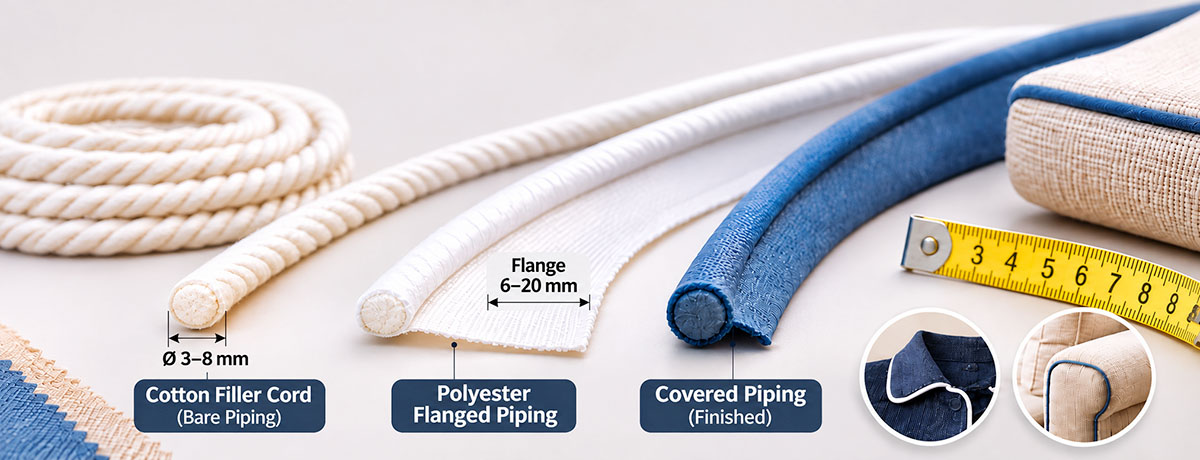
Choose piping cord by the finished edged you need, the product's care requirements and your factory's sewing process. Furniture buyers should assess profile and compression; garment buyers should prioritize drape and seam bulk. Then decide whether to buy bare filler cord for fabric covering or ready-made piping with a sewing flange.
Key Takeaways
Specify bare core diameter, finished cord diameter and flange width separately.
Match material and firmness to fabric, cleaning and production conditions.
Choose flanged piping for insertion into seams; choose bare cord for custom fabric covering.
What Is Your Own Piping Cord Used For?
Piping cord creates a raised edge around seams, cushions, upholstery panels and garment details. Bare cord is enclosed in fabric to make covered piping, also called welting in furniture production. Ready-made piping combines a visible rounded edge with an attachment flange. Unflanged decorative cord is another product, usually supplied for visible trimming.
For furniture manufacturers, piping defines cushion borders and sofa outlines. In clothing production, it can outline collars, cuffs, pockets and panel seams, and it may be combined with specialized components such as rib knit polo shirt collars or structured trousers waistbands and waist tapes. Its main role is edge definition and decoration; it does not automatically reinforce a seam or replace the seam's structural stitching.
Piping cord specification lists cotton cord for dressmaking and upholstery. That overlap shows why the application alone is insufficient: purchasing teams must also describe how the cord will be covered, attached and cleaned, whether they are using lightweight linings, 170T polyester pongee fabric or heavier Oxford fabric for durable covers.
Which Piping Cord Diameter Should Buyers Choose?
Select diameter from an approved sewn sample, rather than a product name or gauge number. Smaller profiles suit discreet garment details; larger profiles create stronger furniture outlines. The acceptable size also depends on fabric thickness, seam construction and the presser foot. The table below gives sampling directions, not universal manufacturing standards.
Application | Profile to sample first | Main approval question |
|---|---|---|
Lightweight garments, collars and pockets | Fine, flexible piping | Does the edge follow the fabric without making the seam bulky? |
Uniforms, jackets and structured clothing | A more defined profile where the design requires it | Does the seam remain comfortable and feed consistently? |
Cushions and removable furniture covers | Mid-size cord; compare available 3–6 mm samples | Is the edge balanced against fabric weight and cushion scale, and compatible with any curtain fabrics and accessories used in the same interior scheme? |
Sofa panels and larger decorative borders | Larger profiles where the design needs emphasis | Can the factory sew curves and intersections cleanly? |
Exposed statement trim | Decorative cord selected by finished outer size | Are appearance, attachment and end finishing acceptable? |
For a real size reference, piping cord range lists twisted cotton at 3, 4, 5 and 6 mm. These are supplier offerings, not prescribed sizes for every cushion. Ask for adjacent sizes and compare them in your actual upholstery fabric.
Separate core diameter, finished diameter and tape width
Core diameter measures the bare filler. Finished diameter measures the visible rounded cord after covering or wrapping. Flange width measures the flat attachment portion. If a supplier quotes overall trim width, request a cross-section drawing showing exactly where that measurement starts and ends.
Covering a cord adds bulk. A thick upholstery fabric can produce a different finished profile from a lightweight garment fabric over the same filler. Avoid converting bare diameter into a guaranteed finished size using a simple calculation: fabric compression, seam position and sewing tension affect the result.
MH's 13 mm polyester piping product describes its measurement as width. Buyers should therefore confirm the rounded profile separately, rather than treating 13 mm as the core diameter.
Cotton, Polyester or Polypropylene: Which Material Fits?
Choose material by the whole piping assembly's performance, including its core, covering and flange. Cotton offers a soft filler option; polyester is used in covered and decorative trims; polypropylene is another furniture-cord option. Fiber names alone cannot establish shrinkage, firmness, colorfastness or suitability for your product's care instructions.
Material or construction | Reasons to consider it | What to verify before bulk approval |
|---|---|---|
Cotton filler cord | Softness and flexibility for fabric-covered edges | Shrinkage after the intended care cycle; consistency of twist and diameter |
Polyester cord or piping | Options for garment edging and decorative furniture trim | Heat response, colorfastness, firmness and compatibility with covering fabric |
Polypropylene filler | An option for furniture and removable-cover projects, and related corded products such as fishing twine lines and nets or plastic packing rope for bundling and shipping | Actual wash performance, heat limits and recovery after compression |
Mixed-material piping | Different fibers can serve the core, covering and flange | Separate composition declarations and care compatibility for each part |
Flanged vs Unflanged Piping Cord: What Should You Order?
Order flanged piping when production needs a ready-made edge that can be positioned and sewn into a seam. Order unflanged bare filler when the factory will cover it in matching or contrasting fabric. Unflanged decorative cord is a third choice: its finished surface remains visible and requires a suitable attachment method.
Purchasing factor | Flanged piping / cord with tape | Unflanged bare filler | Unflanged decorative cord |
|---|---|---|---|
Supplied form | Rounded edge plus flat sewing flange | Cord without fabric covering or flange | Finished visible cord without flange |
Typical process | Insert flange into the seam | Wrap with fabric, then insert piping | Attach according to the trim design |
Appearance control | Approve supplier's visible finish and color | Factory controls covering fabric | Approve twist, sheen and exposed surface |
Main production check | Flange width, stitch position and feeding | Wrapping consistency and finished bulk | Attachment security and end finishing |
Cost comparison | Include insertion labor and waste | Include covering fabric and preparation labor | Include attachment and finishing labor |
MH as a Piping Cord Supplier for B2B Buyers
Ningbo MH supplies garment and textile accessories to business customers, including piping and decorative cording, polyester sewing threads and other garment components, and buyers may also compare retail-style piping cording listings when benchmarking small-pack offers, for furniture and clothing applications. As a leading global provider of garment accessories and tailoring materials, its published range provides a starting point for buyers comparing ready-made flanged trims with other cord constructions. Select a model by the required application, then confirm its dimensions and production suitability.
MH's 10 mm polyester flanged piping cord, model 6207-5002, lists a 10 mm cord width and a separate 20 mm flange. Its garment range also includes the polyester piping product discussed above. Cotton piping cording is also commonly offered in 3 yard bundles, including a 5/32" thickness described as suitable for light and heavyweight fabrics. These examples illustrate why a sourcing request should identify both the product model and the measurement being specified.
For bulk sourcing, send MH your application, drawing, material preference, color reference and quantities by size. Request a sample and a quotation covering packing, minimum order quantity and delivery terms for the selected item. Garment buyers working with delicate, drapey styles may source matching wholesale chiffon fabric alongside piping trims. Benchmark listings may show cotton piping cording at €2.38 per 3 yard bundle, while other market listings show a regular price of $33.89 and a sale price of $26.07. Review any required test documentation against the exact product and order.
To start a sourcing enquiry, contact MH with your specification and request samples for a production trial.


Frequently Asked Questions About Piping Cording
Is piping cord the same as welting cord?
The terms often overlap in upholstery, where filler cord is covered with fabric to form a raised seam edge. They can also describe different supplied products. Ask whether the quotation covers bare filler, finished fabric-covered piping or decorative cord, and confirm the construction with a sample.
Can furniture piping cord be used for clothing?
It may suit some designs, but diameter alone is insufficient. A firm furniture filler can create excessive bulk or stiffness in a garment seam. Sample the proposed cord in the garment fabric and check drape, comfort, pressing and cleaning before adopting it for production.
Does flanged piping still need fabric covering?
Finished decorative flanged piping is generally intended to be inserted with its visible cord surface exposed. Bare filler needs covering when used to make fabric-covered piping. Confirm the supplier's construction: a flange by itself does not establish whether the rounded section has the finish your design requires.
Is polyester piping cord always better than cotton?
Neither material wins every application. Cotton may suit a soft fabric-covered edge; polyester offers other trim constructions and finishes. The decision should follow sample results for firmness, appearance, sewing, cleaning and heat exposure. Compare the complete assemblies rather than relying on the fiber name alone.