
Hook and Eye Closure Tape: Garment Guide for Bulk Buyers
Key Takeaways
-
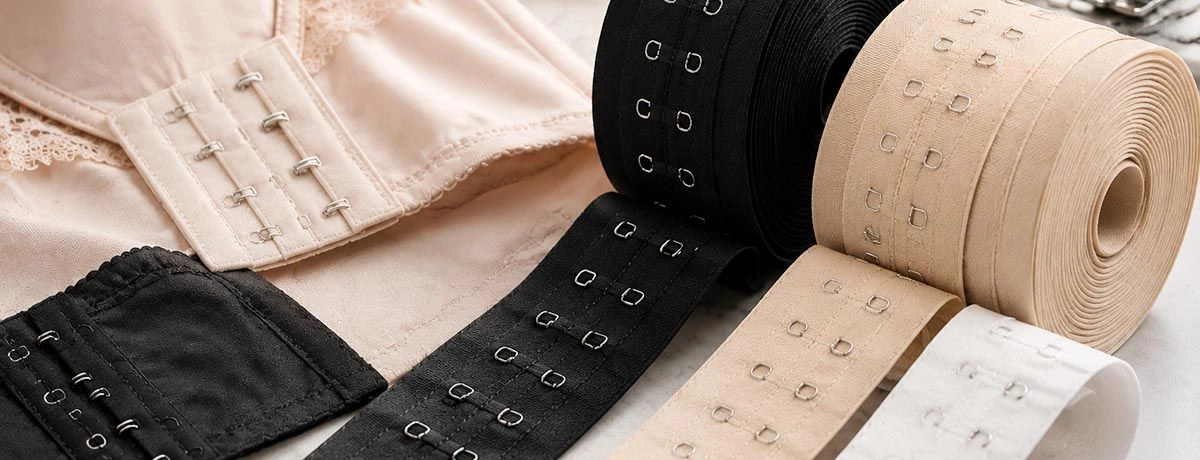
Hook and eye closure tape is a continuous textile fastener system featuring rows of hooks and eyes embedded into fabric tape, designed for high-volume garment production rather than individual retail use.
-
MH operates as a make-to-order supplier, producing hook and eye tape in bulk rolls and cartons for garment factories, brands, and wholesalers - with no ready-stock or retail service.
-
Buyers should specify widths (1/4", 3/4", 1", 1-1/4"), materials, hook finishes, and row configurations in tech packs to receive accurate quotations.
Introduction to Hook and Eye Tape and Closure Tape
Hook and eye closure tape is a continuous textile fastener system used across industrial garment manufacturing. Unlike individual hook and eye pieces attached one at a time by hand, this tape has continuous rows of hooks and eyes embedded into fabric tape, so factories can cut, seal, and sew closures at scale.
It is commonly used in bras, corsets, shapewear, dresses, uniforms, and technical apparel, where secure fastening, consistent appearance, and efficient high-volume production all matter.
Standard production widths range from narrow 1/4" tapes for fine lingerie to wide 1-1/4" hook and eye tape for heavier garments or multi-row fastenings.
Construction and Types of Hook and Eye Tape
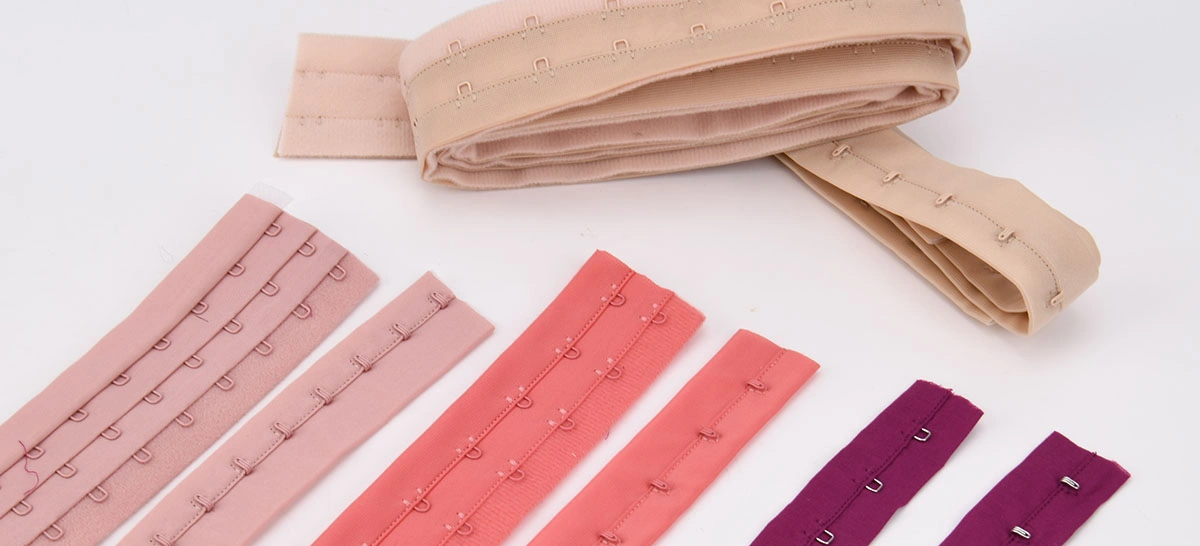
Hook and eye tape consists of two parts: hook and eye. The hook tape carries rows of metal or coated wire hooks with a reinforced edge, while the eye tape (sometimes called the eye side strip) carries corresponding eyelets or loops - often with a soft, brushed backing for skin comfort in lingerie.
When installed, hooks catch into matching eyes for secure fastening. The hook is inserted into the eye to secure garments, creating a closure that lies flat against the body for a seamless look.
Common widths and their garment categories:
|
Tape Width |
Typical Use |
|---|---|
|
1/4" (6mm) |
Fine lingerie, delicate closures |
|
1/2"–3/4" (12–19mm) |
Bra back closures, dress linings |
|
1" (25mm) |
Shapewear side closures, structured dresses |
|
1-1/4" (32mm) |
Corsetry fronts, heavy-duty shapewear |
The closure tape is typically made of cotton, nylon, or polyester. Woven polyester offers stability, while elastic-based tapes with spandex add stretch for sportswear and bras.
MH produces both continuous roll hook and eye tape for automated cutting and attachment, and pre-cut panels used in bra back closures, backed by large-scale garment accessories manufacturing capabilities.


Key Technical Specifications for Professional Buyers
This section works as a buyer's checklist - the specifications you should pin down in every tech pack and purchase order before adding any item to your cart; quotes may be given by roll and, for some programs or sample quantities, by yard.
Dimensional parameters:
-
Tape width: 1/4", 3/8", 3/4", 1", or 1-1/4" with tolerance ±1mm
-
Hook spacing: center-to-center distance typically 8–13mm horizontally
-
Number of rows: single-row for dresses, multi-row (3×2, 4×3) for bras and shapewear
-
Tape thickness: affects sewing machine compatibility and seam allowance planning in relation to sewing machine parts and accessories
Material options:
-
Base tape yarns: polyester, nylon, poly-cotton blends selected to coordinate with industrial sewing thread choices
-
Elastic vs. non-elastic: stretch tape for bras and sportswear; rigid tape for corsets and uniforms
Performance criteria:
-
Pull-out strength: minimum 20 lbs for single hook, 30 lbs for multi-row closures (ASTM D1683 modified)
-
The tape distributes tension evenly across the closure area, reducing stress on individual fastening points
-
Colorfastness: change rating 4.0, stain rating ≥3.5 per ISO 105-E04
-
Corrosion resistance after repeated wash cycles, especially when paired with high-quality zippers for garments
Applications in Garment and Textile Manufacturing
Different garment categories demand different hook and eye tape attributes. Hook and eye tape allows for multiple setting positions for adjustable fit, and the tape adds versatility in garment design while maintaining a clean appearance. It is more suitable for elegant fashion than Velcro-style closures, which is why it dominates in premium categories.
Lingerie and underwear: Multi-row eye tape combined with corresponding hook tape creates bra back closures (3×2 or 3×3 configurations). Soft-backed, brushed eye tape sits on the left side against skin for comfort. Color matching with lace and microfibre fabric is critical for mid- to high-end brands - and hooks and eyes can be color-matched to fabric for a discreet appearance.
Shapewear and corsetry: Wide, reinforced 1 1/4" hook and eye tape handles the compression forces in front or side closures of body shapers and waist trainers. The tape can provide strong fastening in high-stress areas like waistbands, often working together with waistband gripper tape and waistband lining. Careful selection of corrosion-resistant hardware is essential here, as these garments endure frequent laundering.
Dresses, gowns, and tailoring: Narrow, nearly invisible closures at the top of zippers on evening dresses and bridal gowns. Buyers find that color-matched eye tape on the wrong side of the garment creates a clean inside finish. The closure sits on the right hand side or left depending on garment design, with the fold of fabric concealing the tape entirely.
Uniforms and workwear: Closures in protective garments, stage costumes, and adaptive clothing need to fasten and release reliably over tens of thousands of cycles. Stitching durability, supported by reliable polyester sewing thread supply, and hardware corrosion resistance head the spec list for institutional or rental applications.
Production-line integration: Hook and eye tape facilitates easier manufacturing by reducing sewing time. Continuous tape feeding into specialized sewing machines supports consistent quality and high output. This step alone can create meaningful labor savings at scale - a bit of planning on tape format compatibility avoids costly line stoppages.
FAQ
These questions address practical concerns B2B buyers often raise about hook and eye tape procurement beyond what the main sections cover.
What information should I include in my inquiry for hook and eye tape?
Provide tape width (e.g., 3/4", 1", 1-1/4"), number of hook and eye rows, elastic or rigid tape preference, preferred colors, hook finish (e.g., nickel-free), estimated annual volume, and destination country. Pictures or physical samples of your current closure accelerate the quotation process.
Can MH match my existing hook and eye tape from another supplier?
Yes. Send a physical sample or detailed technical drawing with dimensions and material callouts. MH will produce a counter-sample for your approval before mass production begins, ensuring the overlap between old and new supply is seamless.
Can hook and eye tape be integrated into automated sewing lines?
Continuous hook and eye tape supplied on rolls is compatible with many semi-automated and automated attachment machines when combined with appropriate sewing machine needle models. Share your machine specifications and MH can propose the most compatible tape format - including edge finishing method and roll length - to keep your production line running without interruption.
