
What Is a Sewing Thread Colorfastness Test and Why Is It Critical for Quality Control?
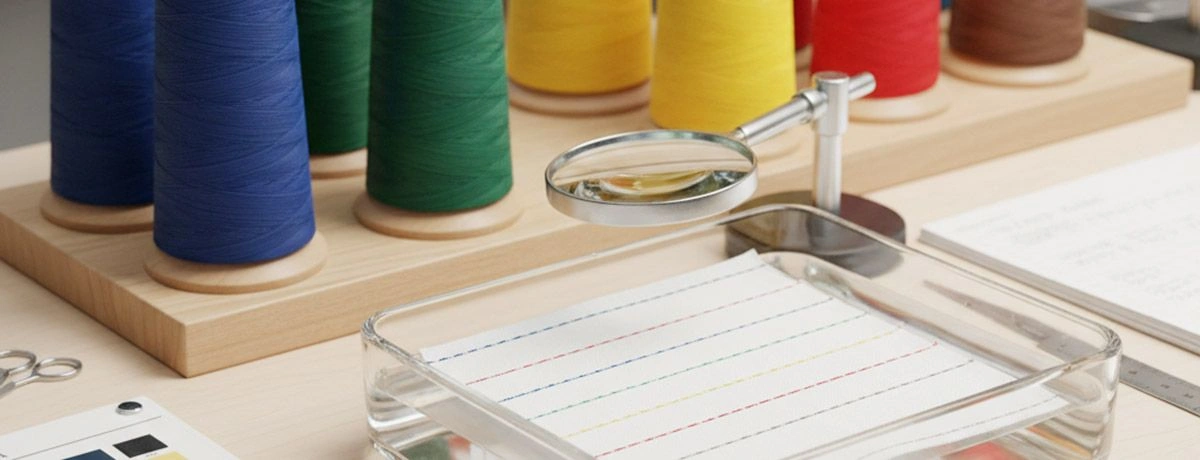
Colorfastness is one of the most important quality indicators in textile materials. In this context, 'colourfastness' refers to the fabric's resistance to fading or colour loss under various conditions such as light exposure, laundering, rubbing, and environmental factors. For sewing thread, colour stability directly affects garment appearance, fabric staining risk, and long-term product performance.
Testing the colorfastness of sewing threads ensures that dyes will not bleed onto your fabric during washing, wear, or exposure to light.
This article explains the sewing thread colorfastness test, including test samples, test methods, washing and rubbing conditions, test results, and how professional factories like Ningbo MH ensure consistent colorfastness across different materials and applications.
What Is a Sewing Thread Colorfastness Test?
A sewing thread colorfastness test refers to the evaluation of how well dyed threads maintain their color when exposed to different conditions such as washing, rubbing, sunlight, perspiration, temperature changes, and cleaning processes.
During testing, test samples are evaluated for:
-
Color change of the thread itself
-
Color staining on adjacent fabrics such as cotton, wool, or silk
-
Resistance to fading, bleeding, or rubbing transfer
Test results are measured using a standardized grey scale, allowing results to be compared across laboratories worldwide.
It is recommended to test threads for colorfastness before use, especially for hand-dyed or darker colors.
Test Samples and Materials Used
In a typical sewing thread colorfastness test:
-
The thread is sewn onto a fabric swatch to simulate real-world use, or wrapped onto the swatch
-
Adjacent fabrics (usually cotton and wool) are added to detect staining
-
A white cloth is commonly used to clearly show color bleed or transfer
A multifiber fabric strip may be attached to the test sample to assess staining and color transfer during the test.
These test samples represent how sewing thread behaves when sewn into most fabrics used in real garment production.
Colorfastness to Washing (Washing Test)
Test Purpose
This test evaluates how sewing thread color reacts to washing and rinsing, especially under repeated laundering.
Test Method and Conditions
-
Samples are washed in cool water or hot water, depending on the test standard
-
Controlled washing time, detergent type, and temperature are applied
-
After washing, samples are rinsed, dried, and examined
What Is Measured
-
Degree of color fading on the thread
-
Staining on adjacent white or colored fabrics
-
Overall color change compared to the original sample
This test is critical for garments that undergo frequent washing or wet cleaning.
Colorfastness to Rubbing (Dry and Wet Rubbing)
Dry Rubbing Test
-
Measures color transfer caused by friction under dry conditions
-
Important for daily wear, movement, and fabric contact
Wet Rubbing Test
-
Simulates rubbing when the fabric or thread is wet
-
Often shows lower resistance than dry rubbing
Test Process
-
A rubbing cloth (usually white cotton) is moved across the test sample
-
Results are compared using a color scale
Rubbing tests are essential for denim, workwear, warp sewing areas, and exposed seams.
Colorfastness to Light (Sunlight Exposure)
Purpose
This test checks how thread color behaves when exposed to sunlight or artificial light over time.
Test Method
-
Samples are exposed to light under controlled temperature and humidity
-
Color fading is compared with reference materials
This test is particularly important for products exposed to outdoor conditions, glass-filtered sunlight, or long-term display.
Colorfastness to Perspiration and Cleaning
Perspiration Test
-
Simulates acidic and alkaline sweat
-
Measures color change and staining after exposure
Dry Cleaning and Wet Cleaning
-
Evaluates thread performance during dry cleaning and professional wet cleaning
-
Important for high-end garments and sensitive textiles
Test Results and Evaluation
Test results are determined by:
-
Comparing original and tested samples
-
Measuring color change and staining using a grey scale
-
Assigning grades that reflect color resistance
A fabric's color fastness is tested against a set of grey scales, with 1 being least colorfast and 5 being most colorfast. While the blue scale is sometimes referenced for evaluating color fastness, a perfect or 'unicorn' result does not actually exist in practical textile testing.
Higher grades indicate better ability to maintain color under different conditions.
Factors That Affect Sewing Thread Colorfastness
Several factors influence test outcomes:
-
Dye type and dyeing method
-
Fiber material (polyester, cotton, silk, etc.)
-
Washing temperature and duration
-
Exposure to light and sunlight
-
Rubbing intensity and moisture level
Threads must be able to stand up to repeated washing, rubbing, and exposure to light without losing color. Darker or vibrant colors are more likely to bleed or fade if not properly fixed. Threads that are hand-dyed are often much less colorfast than threads from larger companies.
Understanding these factors helps manufacturers improve quality and consistency.
Factory Quality Control at Ningbo MH
At Ningbo MH, sewing thread colorfastness testing begins before mass production and continues throughout manufacturing:
-
Begin with raw material and dye selection. Simplified tests are performed to check thread fastness prior to starting larger projects to ensure quality and stability.
-
Laboratory testing under different washing, rubbing, and light conditions
-
Batch inspection to ensure uniform color quality
-
Final testing before shipment
This systematic approach ensures that MH sewing threads meet global quality expectations and perform reliably in real-world use.
Conclusion: Why Sewing Thread Colorfastness Testing Matters
A proper sewing thread colorfastness test helps manufacturers and buyers:
-
Reduce fabric staining risk
-
Prevent premature color fading
-
Ensure consistent textile quality
-
Improve customer satisfaction
Hot pressing is another important test, where fabrics are pressed under specific temperature and pressure conditions to assess how well the thread resists discoloration or fading during pressing processes.
To further improve thread colorfastness, practical methods include using vinegar as a fixative. Soaking threads in a bath of one part white vinegar to three parts water can help set the dye and make threads more colorfast. After soaking, rinsing threads under cool running water helps remove excess dye. For washable fibers, washing threads with baby shampoo can also enhance colorfastness.
When in doubt about a thread's colorfastness, it is advisable to test it before use.
By choosing sewing threads that have been thoroughly tested under multiple conditions, brands can ensure durable color performance across a wide range of fabrics and applications.
Need Sewing Thread with Reliable Colorfastness?
Contact Ningbo MH for technical data, test reports, and customized sewing thread solutions designed for different markets and usage conditions.