
Fabric Ripstop Nylon: Everything You Need to Know
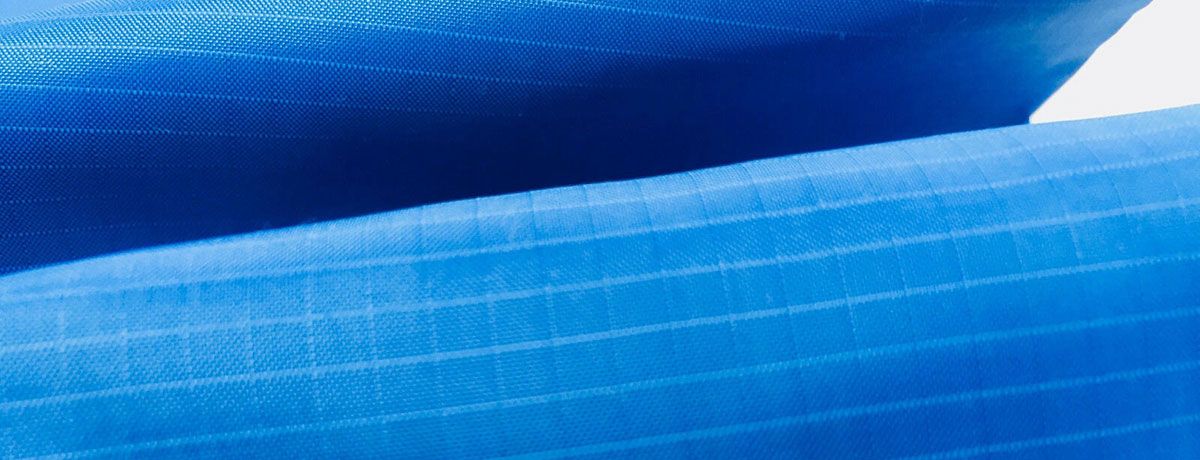
Ripstop nylon is a lightweight plain-weave nylon with thicker reinforcement yarns woven in at regular intervals, usually every 3 to 8 mm, so a puncture stops at the next grid line instead of running across the panel. That grid is the whole product. Everything else on a ripstop spec sheet, the denier, the coating, the finish, decides whether the fabric suits a 40-gram tarp or a 400-gram cargo pant.
Key Takeaways
- Ripstop reinforcement grids typically sit at 3-5 mm (fine), 5-8 mm (standard) or 10 mm+ (coarse); tighter grids mean better tear-stop and slightly more weight.
- Denier is grams per 9,000 metres of yarn, not a quality grade. 20D-70D covers ultralight tarps, 150D-400D covers packs and tent floors, 1000D covers heavy-duty gear.
- UV is nylon's real weakness. Nylon lost 50-60% of tensile strength over a 36-month outdoor exposure test; polyester dropped about 30% in year one and then stabilised.
- Nylon 66 outlasts nylon 6 where heat and abrasion matter: 255-265°C melting point versus 214°C, and roughly 33% better abrasion resistance.
What Is Ripstop Nylon Fabric?
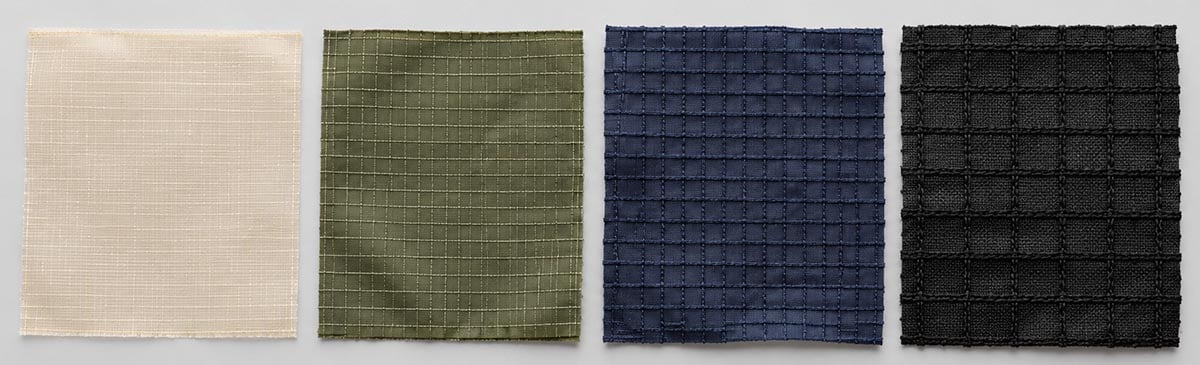
Ripstop nylon is a lightweight nylon fabric woven with a secondary grid of heavier reinforcement yarns spaced at regular intervals across a light plain-weave ground, and that grid is what arrests a tear before it spreads. For manufacturers, designers, and buyers sourcing materials for outdoor gear, technical apparel, military equipment, or workwear, that construction detail is what determines whether a fabric ripstop nylon spec actually balances weight, tear resistance, durability, and cost. Grid spacing generally falls into three bands: fine at 3-5 mm, standard at 5-8 mm, and coarse at 10 mm and above.
You can see this on any ripstop: hold it to the light and the grid shows as a faint crosshatch pattern. It is not printed and it is not embossed. It is structural.
Worth being blunt about one thing: ripstop fabric describes a weave, not a fibre and not a performance class. A 30D uncoated ripstop and a 500D PU-coated ripstop share a name and almost nothing else. We have seen buyers approve a swatch labelled "ripstop nylon" and then receive something two hundred grams heavier that technically met the description. Spec the denier, the finish and the weight, or you have specified nothing.
From there, the useful questions are all specification questions: how the weave structure works, what denier actually tells you, which coatings and finishes change performance, how nylon 6 differs from nylon 66, where nylon outperforms or falls short of polyester on UV resistance, which applications suit each construction, and how to source the right ripstop fabric without getting caught by vague labels.
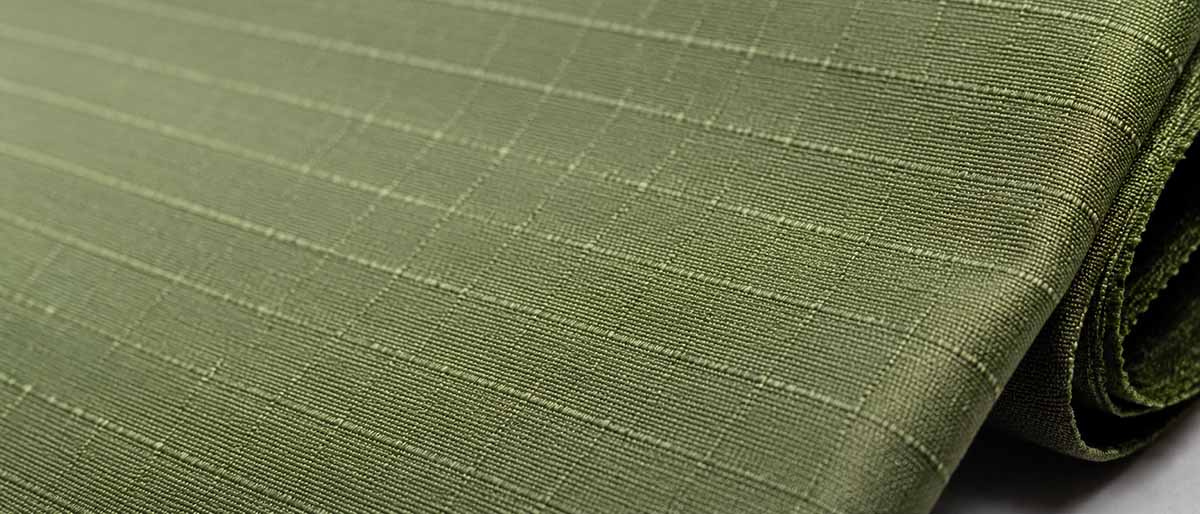
How Do You Read a Ripstop Nylon Spec Sheet?
Denier is the number that does the most work on a ripstop spec sheet, and it means one thing precisely: the mass in grams of 9,000 metres of the yarn. A 70D yarn is not "better" than a 30D yarn, it is simply heavier, and that heavier yarn buys abrasion resistance at the cost of pack weight.
| Denier | Typical use | Trade-off |
|---|---|---|
| 20D-70D | Ultralight tarps, down jacket shells, sil-nylon tents | Lowest weight, needs careful handling |
| 150D | Linings, stuff sacks, ultralight tents | Good all-round light duty |
| 150D-400D | Daypacks, lightweight packs, tent floors, banners | The mainstream working range |
| 420D | Standard packs; the usual abrasion baseline | Durable, still manageable weight |
| 600D-1000D | Luggage, tool bags, protective gear | Heavy, stiff, very abrasion resistant |
Two things denier does not tell you. It says nothing about the finished fabric weight in GSM, because weave density and coating both add grams. And it says nothing about tenacity, so a 70D high-tenacity nylon can outperform a 100D standard nylon on tear. Ask for denier, GSM, width and tear values together, or the number is decoration.
Nylon 6 or nylon 66?
If the product sees heat or hard abrasion, the polymer matters. Nylon 66 melts at 255-265°C against 214°C for nylon 6, and it holds up roughly 33% better under abrasion, surviving about 60,000 cycles where nylon 6 reached 40,000. Nylon 6 is cheaper, dyes more easily and takes impact well. For load-bearing military-style gear the heavier textured nylons are covered by specifications such as MIL-DTL-32439, written for load-bearing vests, field packs and body armour carriers.
Types of Ripstop Nylon, Sorted by Finish
Ripstop nylon is a versatile fabric that splits by finish more than by weave, and the finish is where most of the cost sits. A DWR-only fabric, a PU-coated fabric and a silicone-coated fabric can all start from the same greige roll and end up in completely different products at completely different prices.
-
Uncoated ripstop nylon. Breathable, light, dries fast, not waterproof. Linings, liners, kites, flags.
-
DWR-finished ripstop. A surface treatment that beads water without sealing the fabric. Shell jackets, light outerwear, sportswear.
-
PU-coated ripstop. A polyurethane film on the back. Seam-tapeable, which is why it dominates tent floors and mass-market rainwear. See our guide to PU-coated fabric for how the coating is built up.
-
Silicone-coated ripstop (sil-nylon). Silicone impregnates the yarns rather than sitting on top. Lighter and stronger, but it cannot be seam-taped.
-
FR ripstop. Flame-retardant treated or inherently FR, used in workwear and industrial protective clothing where heavier 600D PU-coated waterproof polyester oxford fabric is also common.
-
UV-stabilised ripstop. Treated for prolonged sun exposure. Sails, awnings, umbrellas.
Ripstop Nylon vs Ripstop Polyester: Which Should You Buy?
Nylon is stronger and lighter for the same denier; polyester wins on sunlight and dimensional stability. The gap is not subtle. In a 36-month outdoor exposure test nylon lost 50-60% of its tensile strength, while polyester dropped roughly 30% in the first year and then levelled off. One study also recorded a 100% tensile loss in unfiltered nylon after 30 days of concentrated exposure against about 44% for polyester.
| Property | Ripstop nylon | Ripstop polyester |
|---|---|---|
| Strength per unit weight | Higher | Lower |
| UV resistance | Poor: 50-60% strength loss over 36 months | Good: about 30% in year one, then stable |
| Water behaviour | Absorbs moisture, stretches when wet | Hydrophobic, dries faster, holds shape |
| Abrasion resistance | Excellent, best in nylon 66 | Good |
| Dimensional stability | Stretches under load | Holds size and shape |
| Cost | Higher | Lower |
The decision rule is short. If the product lives outdoors in the sun (awnings, sails, flags, long-pitch tents), specify polyester. If the product is carried, packed and stressed (packs, parachutes, jackets, ultralight shelters), specify nylon and add a UV stabiliser. For workwear, where the garment is worn outdoors daily but replaced on a cycle, a polyester-cotton ripstop is often the honest answer alongside durable polyester mini-matt fabric, higher-spec 100% polyester mini matt fabric and school-uniform grade polyester fabrics, and it dyes and prints better too.
Ripstop Nylon Applications, Industry by Industry
Ripstop nylon shows up wherever weight and tear resistance both matter, which is why it spans military procurement and fashion at the same time across a variety of applications and practical projects for making hard-wearing items.
-
Outdoor gear. Tents, tarps, hammocks, sleeping bag shells, dry bags, and backpacks. Usually 20D-70D silicone or PU coated, with heavier PVC/PU-coated polyester oxford fabrics for base panels or floors.
-
Technical apparel. Shell jackets, wind layers, hiking trousers, down jacket shells, and stretch pieces in nylon-spandex swimwear and activewear fabric or polyester-spandex four-way stretch woven fabric. Often DWR-finished 20D-40D.
-
Packs and luggage. Daypacks and travel bags in 210D-420D; it is also ideal for creating lightweight packing cubes, with heavier bases at 600D-1000D.
-
Military and tactical. Uniforms, pouches, carriers, parachutes.
-
Workwear and PPE. FR ripstop for industrial and utility clothing, plus coated nonwovens such as PE + SPP medical non-woven fabric and 60gsm PP nonwoven fabric for disposable PPE. See our workwear fabric guide for how ripstop compares to the alternatives.
-
Sails, kites and banners. UV-stabilised grades, since exposure is constant.
Frequently Asked Questions
Is ripstop nylon waterproof?
Not on its own. Uncoated ripstop nylon is wind resistant and quick drying but passes water under pressure. Waterproofing comes from a PU or silicone coating, and PU typically needs two to three times the coating weight of silicone to reach a comparable hydrostatic head.
What denier ripstop nylon should I choose?
Match denier to end use. 20D-70D suits ultralight tarps and shell jackets, 150D-400D covers packs and tent floors, and 600D-1000D handles luggage and protective gear. Denier is yarn mass per 9,000 metres, not a quality grade.
How long does ripstop nylon last outdoors?
Sunlight sets the limit. Nylon lost 50-60% of tensile strength across a 36-month outdoor exposure test, while polyester lost about 30% in year one and then stabilised. For permanently exposed products, specify polyester or a UV-stabilised nylon.
Can ripstop nylon be printed or dyed to a custom color?
Yes, though nylon is less colourfast under UV than polyester. For programmes that need long-term colour retention outdoors, a polyester or polyester-cotton ripstop usually holds shade better. Related reading: our guides to nylon fabrics and taffeta material fabric.
The Short Version
Ripstop nylon earns its place through one structural trick: a reinforcement grid every few millimetres that turns a spreading tear into a contained one.
If the product lives in the sun, look at polyester ripstop before you default to nylon. If it needs to be light and strong and carried, nylon is still the answer.
Need a spec sheet, a tear test or a sample yard against your tech pack? Send us the construction, the target GSM and the end use, and we will quote against it so you can request a quote or place an order once those details are confirmed.