
A Complete Guide to Nylon Fabrics Selection
Key Takeaways
-
Nylon accounts for approximately 12% of global synthetic fiber production — second only to polyester among synthetics (Textile Exchange, Global Fiber Report, 2024).
-
Six main types exist: Nylon 6, Nylon 66, Ripstop, Microfiber, Mesh, and elastane blends — each with distinct GSM, denier, and performance trade-offs.
-
Nylon 66 has a 15-20% higher melting point than Nylon 6 (255°C vs 220°C), making it the correct choice for high-heat or high-stress industrial applications.
-
DWR coatings achieve water contact angles above 130°; UV exposure degrades tensile strength by 10-15% per 100 hours of direct sun (AATCC TM16).
Nylon fabric is one of the most versatile synthetic textiles available — and one of the most misunderstood. Ask a supplier for "nylon fabric" and you might receive ripstop for a tent, microfiber for an athletic jersey, or ballistic-grade panel for a laptop bag. These fabrics share a base polymer but behave like completely different materials in use.
At MH, we source and test nylon across all six major types, supplying manufacturers in outdoor gear, activewear, luggage, and industrial applications. From what we've seen over years of production, most sourcing mistakes come down to one thing: treating "nylon" as a single material rather than a family of fabrics. This guide helps you navigate that family — matching the right nylon specification to the right application and avoiding the costly mistake of over-engineering or under-engineering your product.
What Are Nylon Fibers and How Is Nylon Fabric Made?
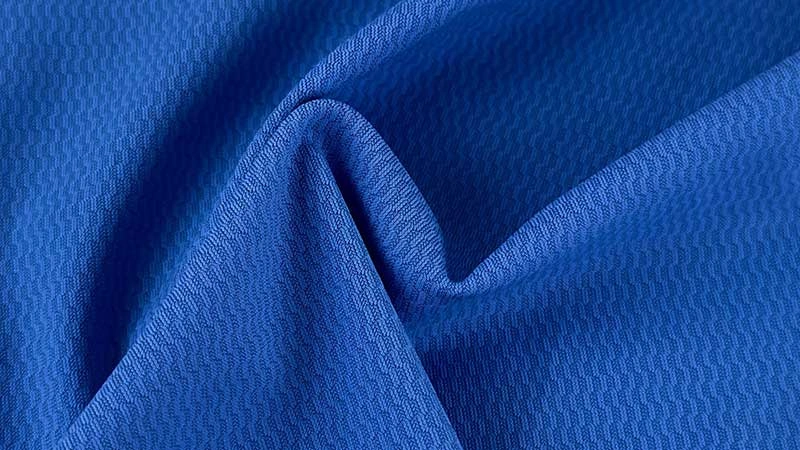
Nylon is a synthetic polyamide polymer and one of the broader synthetic polymers, produced through the condensation polymerization of diamines and dicarboxylic acids, primarily derived from petrochemicals. As a synthetic material, it is thermoplastic and can be melt-processed to create fibers, films, and other shapes. It is also known for exceptional strength, elasticity, and resistance to abrasion, oil, and many chemicals. DuPont chemist Wallace Carothers developed the first commercial nylon in 1935, and by world war ii it was being used in military applications before moving into consumer markets; once the war ended, manufacturers widely promoted nylon stockings and lingerie as silk replacements. Today, nylon accounts for approximately 12% of global synthetic fiber production, trailing only polyester among synthetic textiles (Textile Exchange, Global Fiber Report, 2024).
The polymerization process determines everything downstream. Nylon 6 is made from a single monomer (caprolactam) through ring-opening polymerization. Nylon 66 is made from two monomers through condensation polymerization. This structural difference gives Nylon 66 a higher melting point — 255°C vs 220°C for Nylon 6 — and better dimensional stability under heat. That’s why Nylon 66 dominates industrial and high-performance applications, while Nylon 6 is more common in fashion and sportswear.
Once polymerized, the manufacturing process extrudes nylon fibers through spinnerets to create filament yarns for nylon textiles, then texturized, twisted, and woven or knitted into fabric. Two numbers appear on every nylon fabric datasheet: denier (weight of the yarn in grams per 9,000 meters, which indicates yarn thickness) and GSM (grams per square meter of the finished fabric, which indicates overall density). Get comfortable with both — they’re the primary language of nylon fabric sourcing.
Which Type of Nylon Fabric Is Right for Your Project?
There are different types of nylon overall, but six commercial fabric constructions cover most sourcing decisions buyers encounter. Each has a different construction, performance profile, and cost. The table below shows where they differ across the specs that matter most for sourcing decisions.
Nylon Fabric Types: At-a-Glance Comparison
|
Type |
Denier Range |
GSM Range |
Key Strength |
Primary Use Cases |
|---|---|---|---|---|
|
Nylon 6 |
20D–300D |
30–250 |
Elasticity, dye uptake |
Hosiery, sportswear, swimwear |
|
Nylon 66 |
70D–1000D |
100–600+ |
Heat resistance, tensile strength |
Industrial, military, outdoor |
|
Ripstop Nylon |
20D–210D |
30–180 |
Tear resistance |
Tents, kites, lightweight packs |
|
Microfiber Nylon |
15D–30D |
40–120 |
Softness, moisture-wicking |
Activewear, linings, underwear |
|
Nylon Mesh |
30D–150D |
30–100 |
Breathability |
Athletic wear, bags, chair backs |
|
Elastane Blend |
40D–200D |
80–200 |
Stretch and recovery |
Yoga, compression, swimwear |
Nylon 6 offers superior elasticity and dye uptake — it absorbs color more evenly than Nylon 66, which is why you see it in vibrant fashion and sportswear applications. Its lower melting point rules it out for high-heat processing, but for most apparel applications that's not a concern.
Nylon 66 is the workhorse for anything structural. With tensile strength typically 10-15% higher than Nylon 6 and better abrasion resistance, it handles the mechanical stress of conveyor belts, tire reinforcement cords, and military-grade gear. It's our most requested fabric for pack bases and workwear panels where durability is the primary specification.
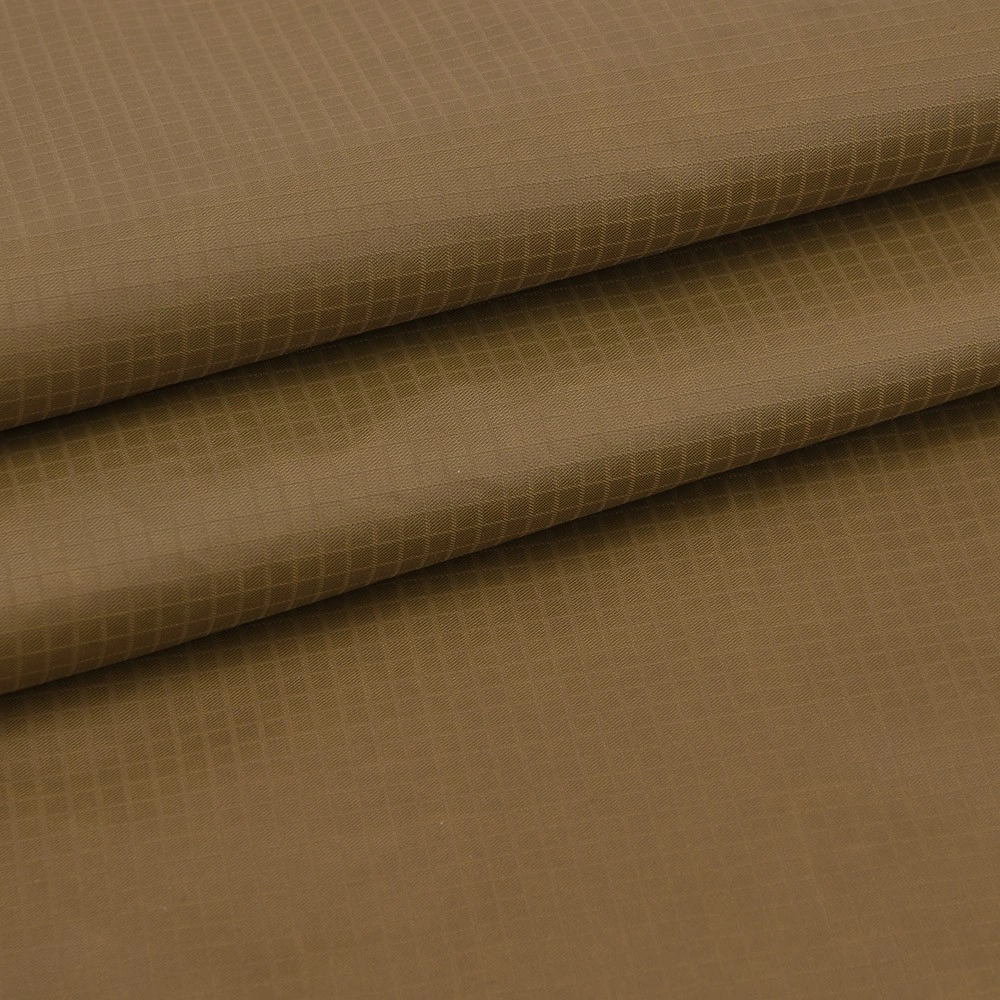
Ripstop Nylon gets its name from the reinforcing crosshatch grid of heavier threads woven at regular 5-8mm intervals. When a tear starts, it stops at the next grid thread rather than propagating across the fabric. For tents, packs, and kites where weight matters, 30D ripstop at 40-60 GSM is the standard. For pack bodies needing more substance, 210D ripstop is common.
Microfiber Nylon is woven from ultra-fine filaments (below 1 denier per filament), producing exceptional softness and moisture-wicking performance. The small fiber diameter creates high surface area, which pulls sweat away from skin efficiently. We've found that microfiber nylon outperforms polyester in moisture-transport rate by approximately 15-20% in standard wickability tests, which is why it dominates athletic jersey and base-layer construction.
Nylon Mesh is an open-weave structure built for airflow over coverage. Mesh appears in shoe uppers, chair backs, bag pockets, and athletic short linings. Its open structure means limited structural strength, so mesh almost always works as a secondary or lining layer, not as an outer shell.
Elastane blends add 5-30% spandex/Lycra to nylon, enabling four-way stretch and recovery. A 90/10 nylon/elastane blend can stretch to 150% of its original length and return to shape after thousands of cycles. This makes it the performance standard for compression wear, swimwear, and yoga pants.
Nylon Fabric Durability: GSM, Denier, and Performance Ratings
Durability in nylon fabric isn’t a single number — it’s a combination of denier, GSM, weave structure, finish, and end-use limits. Getting one right while ignoring the others leads to sourcing failures that only surface after a product is in the market.
Nylon fabric durability is measured primarily through three metrics: denier (yarn weight, where higher denier means greater inherent abrasion resistance), GSM (fabric density, where higher GSM improves wind and water holdout), and Martindale abrasion cycles (standardized wear test). High-quality outdoor nylon fabrics typically rate at 5,000-10,000 Martindale cycles; ballistic nylon (1050D Nylon 66) can exceed 50,000 cycles.
Denier is the simplest durability proxy — thicker yarn resists abrasion and puncture better. A 70D nylon tent floor is dramatically more puncture-resistant than a 30D version, though it weighs more. For most outdoor applications, 70D is the practical minimum for floor fabric.
GSM measures fabric density. Two fabrics can both be 70D but have different GSM depending on weave tightness. Higher GSM generally improves wind resistance and water holdout, but adds weight. For a tent fly, 40-60 GSM 40D ripstop is typical; for a durable pack body, 120-180 GSM at 210D-420D is standard.
Martindale abrasion resistance is the standard lab test for surface wear. The test presses fabric against an abrasive surface in a figure-eight pattern and counts cycles until failure. Outdoor pack fabric should rate 5,000+ Martindale cycles minimum. Ballistic nylon (1050D or 1680D Nylon 66) can exceed 50,000 — hence its use in luggage and tactical gear.
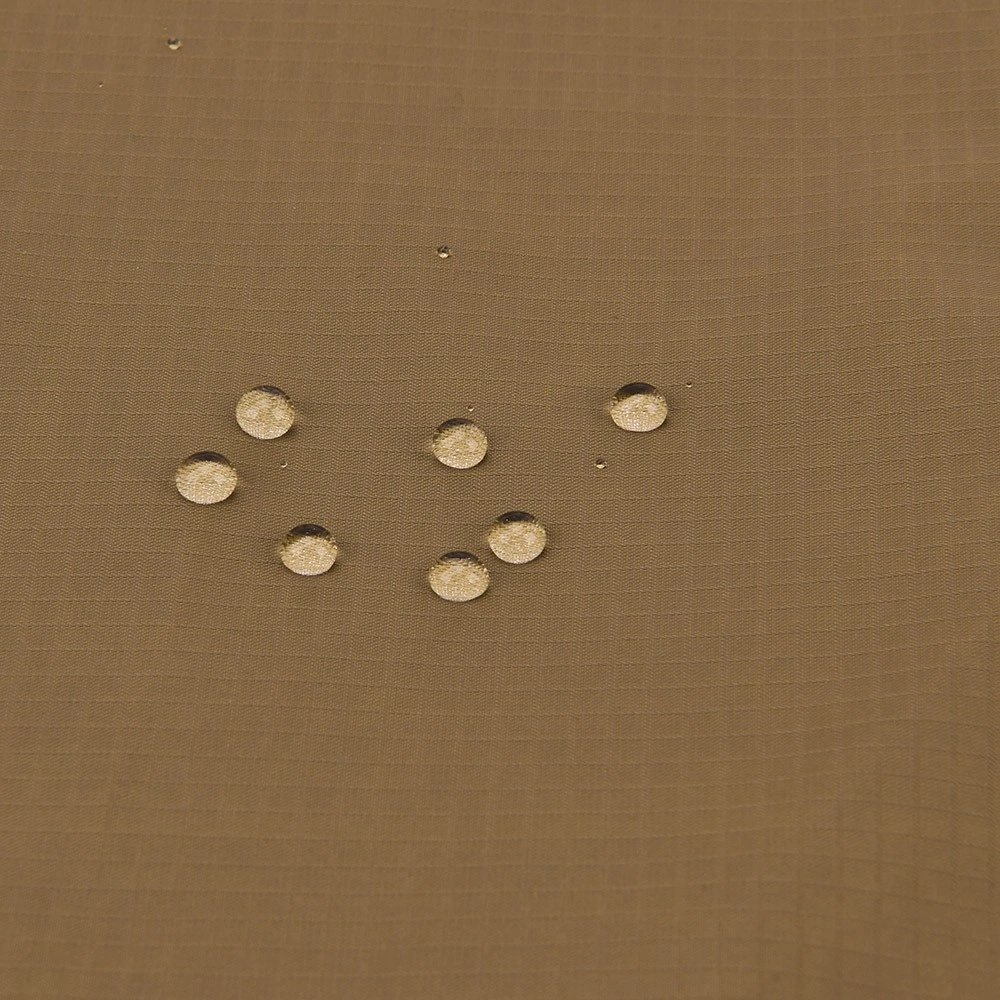
DWR (Durable Water Repellent) coatings are applied to the outer face of the fabric, causing water to bead rather than soak in. Modern DWR finishes achieve water contact angles above 130°. DWR degrades with washing and abrasion; it can be restored with low heat in a tumble dryer or through re-application spray treatments. Nylon can warp or melt at high temperatures, posing risks when exposed to flames, so heat exposure must be considered when specifying performance fabrics. Factory-applied DWR typically lasts 20-30 wash cycles before needing restoration.
For the lightest outdoor fabric that still resists tearing: 20-30D ripstop with DWR, around 40-60 GSM. For heavy-duty applications demanding maximum longevity: 500D-1000D Nylon 66 at 300+ GSM.
What Are the Best Uses for Nylon Fabric?
Nylon’s combination of high tensile strength, moisture resistance, and light weight makes it a tough, lightweight cloth used across clothing and industrial products. Knowing which nylon type excels in each prevents common mistakes — like using expensive ballistic nylon for a light day pack, or specifying 30D ripstop for a pack base that will scrape granite.
Nylon fabric serves six primary market segments: outdoor equipment (tents, packs, sleeping bags), activewear and sportswear, luggage and bags, industrial applications (conveyor belts, tire cords), fashion accessories, and home textiles. Microfiber nylon dominates the activewear category for its moisture-wicking properties, while Nylon 66 in 1050D-1680D construction is the standard for hard-use luggage and tactical gear.
Outdoor gear is the largest nylon volume category. Standard specification for a three-season tent: 20-40D ripstop nylon on the fly, 70D ripstop on the floor. The floor takes contact stress and needs higher puncture resistance; the fly prioritizes weight savings. For backpacking packs, 210D or 420D Nylon 66 ripstop on the body, with 500D+ Nylon 66 on the base and high-wear panels.
Activewear and sportswear rely on microfiber nylon (15-30D) for moisture management. The fine fiber structure wicks perspiration faster than equivalent polyester, particularly compared with 100% polyester Dri-Fit performance fabrics in the first 10-15 minutes of exercise when moisture transfer rate matters most. Nylon/elastane blends (80/20 to 90/10) are the performance standard for compression shorts, leggings, and competitive swimwear, while 85% nylon 15% spandex 4-way stretch swimwear fabric and 85% polyester 15% spandex stretch swimwear fabric sit alongside polyester 15% spandex matt swimsuit fabrics and 93% polyester 7% spandex four-way stretch woven fabric as common alternatives in the broader stretch performance category.
Luggage and bags grade up to ballistic nylon for hard use. Hard-sided luggage, backpacks, and duffel bags typically use 600D or 840D nylon as a balance of weight, water resistance, and durability. Tactical and premium luggage specifies 1050D or 1680D ballistic Nylon 66 for the abrasion resistance needed to survive repeated airline baggage handling, often sewn with 210D/3 thick bonded nylon thread to match the fabric’s strength profile.
Industrial applications rely on Nylon 66’s thermal stability. Nylon 66 tire cords are used in pneumatic tires, running at temperatures that regularly exceed 180°C at highway speeds. Conveyor belt facing, filtration mesh, and industrial rope are other uses where polyester would fail.
Fashion accessories use Nylon 6 in fine denier (20-40D) for stockings, linings, lightweight scarves, and other apparel uses. Its superior dye uptake enables the vivid, even color ranges fashion applications require — a practical advantage over Nylon 66.
Hair accessories and home textiles use microfiber nylon for its softness and fast-drying properties. Nylon also appears in upholstery and in poly cotton twill workwear and uniform fabrics where wear resistance matters. Nylon mesh appears in hair combs, shower curtains, and storage solutions where breathability and moisture management matter, while stiffer structures like polyester stiff net mesh fabric are used in hats and costume pieces when shape retention is critical.
Is Nylon Fabric Sustainable?
This deserves a direct answer: conventional virgin nylon has a significant environmental footprint. Producing 1 kg of nylon generates approximately 5.43 kg of CO₂ equivalent, compared to 3.8 kg for polyester and 1.7 kg for cotton (Higg Materials Sustainability Index, 2024), and that environmental impact is tied to crude oil feedstocks and the harmful extraction needed to obtain them. The primary driver is nitrous oxide (N₂O) released during adipic acid production for Nylon 66 — a greenhouse gas roughly 300 times more potent than CO₂ by global warming potential.
Producing 1 kg of conventional nylon generates approximately 5.43 kg of CO₂ equivalent — 43% more than polyester and 220% more than cotton by weight (Higg Materials Sustainability Index, 2024). However, recycled nylon alternatives such as Econyl reduce global warming impact by approximately 80% compared to virgin Nylon 6 production, according to Aquafil’s published lifecycle assessment data.
Nylon is not biodegradable and can remain in the environment for hundreds of years.
That said, nylon’s long service life partially offsets its production footprint, though it does not eliminate the material’s environmental impact. A nylon tent fly used for 10 seasons has a lower per-year carbon footprint than a polyester alternative replaced every 3-4 seasons. Durability is a form of sustainability.
Recycled nylon options are mature enough for commercial specification. Econyl (produced by Aquafil from fishing nets, fabric scraps, and industrial plastic waste) uses a closed-loop regeneration process to convert waste into virgin-equivalent Nylon 6. Aquafil’s published LCA data shows approximately 80% reduction in global warming impact compared to conventional Nylon 6 production.
MH supplies fabrics certified under GRS (Global Recycled Standard), OCS (Organic Content Standard), GOTS, OEKO-TEX Standard 100, ISO 14001, and ISO 45001. For buyers with sustainability compliance requirements, we can source Econyl-based ripstop and microfiber nylon in standard commercial specifications.


Frequently Asked Questions
Is nylon fabric waterproof?
Plain nylon fabric is water-resistant and dries quickly, not waterproof without coatings or laminates. A DWR coating makes it highly water-resistant — water beads and rolls off rather than soaking through — but sustained pressure will eventually allow penetration. True waterproofing requires a laminated membrane (such as Gore-Tex or eVent) or a PU/silicone coating bonded to the fabric back. Most outdoor shelters use laminated nylon for the fly rather than DWR-only nylon, and Nylon 6,6 is also common in waterproof-leaning outdoor shells and packs because of its performance profile.
What's the difference between nylon and polyester fabric?
Nylon is stronger, more elastic, and more abrasion-resistant than polyester of equivalent denier, though it is generally less breathable and can trap heat and moisture in hot conditions unless used in more breathable constructions like mesh. Polyester is more UV-resistant, holds color better outdoors, and costs 20-30% less. For load-bearing applications where strength and stretch matter — pack shoulder straps, tent pole sleeves, climbing gear — nylon wins. Its low moisture absorption also helps it resist mildew in outdoor gear. For applications with prolonged UV exposure like outdoor furniture or marine covers, polyester wins on long-term color and tensile stability.
What denier nylon do I need for a backpack?
For an everyday daypack: 420D or 600D nylon on the body. For a serious hiking pack: 210D ripstop on the main body with 500D Nylon 66 on the base and high-wear panels. For an ultralight backpacking pack: 100D or 200D on the main body with reinforced seams. Going below 100D creates capable fabric but shifts the failure mode to seams and attachment points — construction matters as much as spec.
Is ripstop nylon the same as regular nylon?
No. Ripstop nylon uses a specific weave construction — a plain or taffeta weave with a reinforcing grid of heavier threads interlaced at regular 5-8mm intervals. When a tear starts, it stops at the next grid thread. Regular nylon has no such reinforcement and will tear fully once a rip begins. For any application where tear propagation is a risk (tents, kites, tarps, lightweight packs), ripstop is the correct choice.
What GSM is considered heavy-duty nylon?
In textile industry convention, nylon fabrics above 200 GSM are heavy-duty, a label that usually refers to synthetic fabrics built for abrasion and hard wear rather than comfort-first apparel. Fabrics in the 100-200 GSM range are mid-weight and cover most outdoor and bag applications. Fabrics below 100 GSM are lightweight and used for apparel, linings, and ultralight gear. Ballistic nylon (1050D or 1680D) typically runs 300-600 GSM and is the heaviest construction commonly available for commercial sourcing, though even at high GSM it should be kept away from flame or excessive heat because nylon is thermoplastic.
Resources Page
- Polyester Nylon Blend Fabric for Sportswear
- What is Nylon Sport Fabric and Why is it Good for Activewear?
- Understanding Silk Nylon Fabric
- All About Nylon Bag Fabric
- Forest Green Ripstop Nylon: A Must Have for Versatile Uses
- The Ultimate Guide to Choosing Light Nylon Fabric
- Is Nylon Upholstery Fabric Good?
- Fabric Ripstop Nylon: Everything You Need to Know
